Sunday, May 27, 2012


The conversation was giddy – like excited monkeys calling to one another across the treetops- we bantered, quipped and dreamed aloud . The small confines of our transfer bus was bursting at the seams with energy – the one that would deposit us at the doorstep to a plane that would take the Flight of the Angels from Johannesburg to Victoria Falls, Zimbabwe.
From the air, the landscape was a gnarled form of dry rivers stretching to the horizon in shades of red, sandy beige and muted green. The straight lines of roads cut like scars into its organic surface. The air breathed in layers of white, turquoise and limitless blue.
Zimbabwe, once one of Africa’s most iconic destinations, is now a land bruised by its past with an uncertain future. The popular bookstores of South Africa delight in travel guide books of all sorts, yet finding a Lonely Planet or Frommer’s of Zimbabwe feels more like panning for gold. Clouds cross over the eyes of loved ones at the news – I am going to Zimbabwe.
This is the first introduction to Africa Time to many in the que – “these some few minutes” – as they say. Thankfully, I know the drill and look on with resigned amusement. Eventually, we are released from our Pergatory.
The airport is a relic – built in the ’70′s it stands like a time capsule. The flood of excitement of my fellow passengers starts to recede in dramatic measure, replaced by clock-watching and smart comments. The line for Immigration inches on, the sounds of endless stamping “bang-bang-bang” answering our grumblings as the voice of apparent productivity.
Driving from the airport into town we pass locals walking under the shade of umbrellas and our driver pulls aside for Baboons making an appearance on the side of the road, much to the delight of my fellow passengers who exclaimin in unison, “Monkeeeeys!”.
We pass a sign marking the start of the Victoria Falls National Park. Formed by metal lettering attached to a backing, the word “National” has nearly fallen off. Hanging on by just one of its last letters, it sways from side to side, saying more than it intends to.
The town of Victoria Falls is tiny – only two main roads, lined with shops, hotels and adventure companies. Our driver notes with a twinkle in his eye that we may well see wild animals roaming the streets – entirely possible, yes, but likely? Not so much.
The wildest encounter is probably one with the locals selling souveniers, who invite you to come to the craft market with desperation in their eyes. They walk along with you, offering to barter – for soap, my sandles, or the American dollar. Personal space is foreign, they close in, constantly asking, offering, pleading. They follow me a long way. Three to one – it is uncomfortable. Suddenly they make a hasty retreat in view of uniformed Tourism Officers, there to ensure tourists are not harassed.
I breath silent relief and look skyward to tomorrow’s treasure – the mist of Victoria Falls, visible from where I am standing. This is the breath of the Zambezi, rising from a great crack in the Earth up towards the heavens. Tomorrow, I think, Victoria Falls will rain on me.

Tuesday, March 27, 2012

Smear Fear: How Regular Pap Screenings Can Be the Key to Your Health

As women we endure all sorts of discomforts. Some of them are self-imposed, mind you. Waxing comes to mind, three inch heels, the girdle. If aliens were to observe us they might be forgiven for thinking of these things as some sort of torture, yet we ladies don't even bat our perfectly curled, mascarad lashes at them.

We are fearless in the face of beauty.

On the other hand, there are some facts of life to which we simply cringe. Strange looking spiders, taking out the rubbish, appointments to see the gynaecologist.

Yes, that's right. The dreaded Pap smear - the thing we all know we are supposed to have regularly but somehow find ways to avoid for as long as possible. And why not - we feel healthy enough, we feel young enough. And anyway, there's no one there to remind us about it except ourselves. And so we delay.

The thing is, regular Pap smears are the only thing that stands between us and, if luck is against you, preventing cervical cancer. That's right - the C-word. But it's not as scary as you think.

Cervical cancer has almost no symptoms in its early stages, yet is one of the most preventable types of cancer out there. By having an annual Pap smear, you and your doctor are keeping track of the health of your cervix, and monitoring any changes that could, if left untreated, lead to cancer.

This is healthcare in its truest form - not "sickcare". Modern medicine is so advanced these days that we can get a second chance, which is exactly what happened to me.

The Pap smear is the first step in identifying any abnormal cells in your cervix. If any are found, the level of the abnormality is graded from CIN 1 and 2, up to 3. After finding ways to delay my Pap smear (I skipped one... oh, ok maybe two), I landed up with a CIN 3. This is considered to be a pre-cancerous stage.

There's that C-word again, and I panicked. I am in my early-30's and not ready for children- just yet. My future and all of its never-to-be-fulfilled dreams swept before my eyes, and I felt as if I had just missed the bus on the road to my life.

But I needn't have worried.

For some reason, we ladies keep this kind of experience to ourselves when it happens. Only when we have a friend or a relative encounter the same bump in the road do we feel it necessary to share our story. The thing is, my situation is apparently more common than I thought - which is to say I thought I was the only one on the planet going through it - and I took great comfort in speaking to other women and realising that they hadn't missed their bus, and there was no reason for me miss mine either.

I went to see a specialist, who performed a colposcopy- which is a scary-sounding word for an relatively-nothing exam. A solution is washed over your cervix that reveals any funny-bits for closer examination through a sort of magnifying glass. The abnormal area can then be observed, and in some cases a biopsy will be taken for lab testing. In my case I was scheduled for the LLETZ procedure, a minor surgery where the abnormal cells are removed using an electro-magnetic current that requires relatively little recovery time. In some cases, if all of the abnormal cells are removed in the LLETZ procedure, this is the only treatment that is required.

I was still a nervous wreck when it came time to check into the hospital. I arrived at 6AM, along with all of the other soon-to-be-patients scheduled for surgery that morning. It was easy to see which of us were the sitting ducks and which were there for support. Those of us on the Ducks Team sat with pinched smiles transfixed on our faces while those on the Support Team looked around aimlessly whilst alternating between big, greedy yawns and slurping at their coffee.

I had never wished to be slurping a coffee more in all of my life.

Once I checked in I was shown to my bed for the morning, my backless gown and the most gigantic pair of disposable panties ever known to man. One size does not fit all, it must be said. As they wheeled me down to theatre I felt rather silly- afterall, I still had the use of my legs- but with the backless gown and giant panties, walking myself was clearly out of the question.

Once in theatre I looked up at the ceiling while things were passed over me, just like the movies, before the anaesthetist- who goes by the name of Pieter Uys (this is not a joke)- demonstrated that he was in fact an anaesthetist and not the cross-dressing political satirist that goes by the same name. This was of course a great relief to me, given the circumstances.

When I woke up it was all over and I had no recollection of anything since my introduction to Doctor Uys. I had a fabulous nap, snacked on a cheese and cucumber sandwich and caught up on emails whilst in recovery. A nip here and a tuck there, my procedure had been a complete success. I walked out the door a few hours later a brand new woman.

I was fearless in the face of health.

***
The Pap smear is a screening test used to detect abnormal cells in your cervix, including the earliest signs of cancer. If you are sexually active or over the age of 21, you should have regular Pap smears. Talk to your doctor about how often is right for you.

Wednesday, March 7, 2012

River Dawn: Fishing & Birdwatching in the Garden Route, South Africa


A sleepy sun is rising, unfurling the colours of the day in pink and golden yellow, in her soft, warming light. Like glitter it shines over the landscape of hillside mansions, lighting each window like glowing candles. Hidden spider webs are revealed in the silvery dew.

There's a cool breeze moving over the center of the river. With each long finger it ruffles the surface, yet forgives the edges on the shoreline, leaving them to their inky smooth reflections. Piles of seaweed, ankle-deep, lie patiently waiting for the tide to come and take them back home again.

Morning solitude is interrupted by the sound of calling birds gliding past. The elegant Black-winged Stilt, the drumming African Snipe. African Darters dry their wings on the riverbanks while Blue Cranes observe from a distance.

The casting of the line - zhhhhhhh- and its gentle drop - blloooop - into the deep adds anticipation to the chorus. Energy levels are rising, along with the tide and the sun.

This is a convergence of life- the meeting place between land, two rivers and the sea. The Bitou, the Keurbooms, the Indian Ocean - this is fishing in the Garden Route, South Africa.

Sunday, March 4, 2012

Shipwreck & Secret Treasure: Arniston, South Africa

Renowned as an idyllic coastal retreat, Theresa Lozier discovers that Arniston’s white sandy beaches and turquoise sea harbour even more hidden beauty than first meets the eye.

“So you want to see the secret cave?” asked my host, Robert Haarburger, nonchalantely motioning to a small, dark crack in the ground. I laughed out loud, thinking he was making a joke, “Yeah, sure I do” but his look told me he was serious, and then the penny dropped. I stammered, “You mean you want me to crawl through… that… hole?” It looked tiny and I couldn’t imagine it would lead to anything but a terrifying, bat-infested, spider-riddled death. “You first” he smiled brightly, “you’re a lot younger than me.”

We were standing on a vertical cliff, one of the most distinquishing features of Arniston’s rugged limestone coastline which has, over the millenia, been sculpted to the whim of the wind and the sea like proverbial Playdough. Today it forms a series of dramatic arches, outcrops, contours, clefts, ridges, overhangs and caves.

The most famous of these is Waenhuiskrans, meaning ‘wagon house cliff’, so named because Dutch settlers believed it was big enough for an ox-wagon to turn around in. This is a reference that means little to us today – perhaps a comparison to a double-cab Toyota Hilux would be more appropriate, but nonetheless, it is a rather large space. Submerged at high tide and pounded by incredible surf in between, low tide reveals a small entrance, giving the intrepid the chance to steal a few moments in this uninhabitable space.

This is a place where the dark, dripping rocks inside contrast against the brightly lit and splashing turquoise outside – an experience that makes your heart beat with almost the same force as the crashing of the waves.
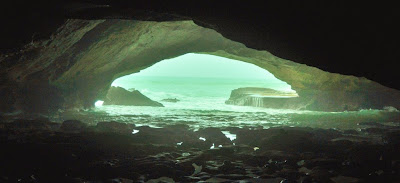
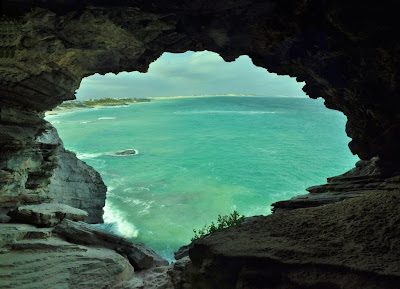
But now I was about to see another one of Arniston’s secrets, a lesser known cave which might have served as shelter to the ancient Strandlopers, or at the very least to a few jovial characters over a modern campfire in our more carefree age. Robert looked amused as I wedged myself into the hole, legs dangling, arms gripping, my feet searching for a landing. Small rocks dislodged and disappeard into the darkness beneath me. Finally I touched down and Robert scrambled in behind me. The cave was room-sized and offered a view over Arniston framed by its own ragged-edged eye. The rumbling of the waves as the sea heaved itself against the rocks below us sounded deep and powerful while the sight of birds gliding by just out of reach in the window of the cave’s opening formed a tranquil scene, all to the soundtrack of the whistling wind.
Robert Haarburger is an Arniston local – he grew up here, traveled and lived overseas, and eventually returned two decades ago, transforming property that his family owned into some of the only sources of local employment in the village – the relaxed Arniston Seaside Cottages, and the iconic Arniston Hotel. He says with the shrug of a man resigned to the temptation of his heart, “People told me I was crazy to return, but I love Arniston. No matter where I travel in the world, it always calls me back, like it has a piece of my heart.”

We clambered out of the cave and into Robert’s waiting dune buggy, which looked equipped to take us just about anywhere. Our trusty sidekick went by the name of Trigger – Robert’s English Pointer – a friendly dog with melt-your-heart brown eyes and a boundless energy that justified his name.

Trigger spent most of the day intermittently launching himself from the back of the buggy, springboarding onto my lap and out, to gallop (and I do mean gallop) just ahead as we made our way around the Nature Reserve. From the Struispunt Beacon, past ancient middens (heaps of ancient shells, bone and other artefacts discarded by Strandlopers from the Middle Stone Age… ) to the farthest reaches of the bay along a bumpy, muddy, sandy all-terrain road that eventually peeled away to reveal the windswept horizon, crashing surf, rocky coast and more of that turquiose water – Arniston offered up her little-known treasures from every vantage point.

Two-hours from Cape Town, Arniston is accessible along a finger of road that extends 25-kilometers past the closest town, Bredasdorp, towards the southern reaches of South Africa’s coast. Relatively isolated and undeveloped, Arniston is known as a coastal retreat. Set against an aquamarine sea, the village is dotted with thatch-roofed white-washed cottages, the most famous ones forming the 200-year old Kassiesbai, home to generations of villagers – in fact, the only people allowed to live there are the few that have been born there.

Two of these villagers, Connie and Byron, took some time to show me around and together we wandered the paths between the historic buildings while curious children trailed behind us like we were part of the Pied Piper’s secret envoy. They pointed out the local Craft Market and Willene’s, a restaurant where tourists can enjoy a local’s meal, along with the cottages of their family, neighbors and a few which stood empty after the passing of another generation. It was clear that they were part of a close-knit community that was more like their family.

Both were employed at the Arniston Bay Hotel – Byron was trained as a Pastry Chef and Connie a Manageress, who – like Robert Haarburger, once left Arniston for greener pastures but was eventually lured home. Gazing out over the aquamarine horizon, she explained, “I went to Cape Town for a while. It was exciting but…” she trailed off before facing me with a Judy Garland smile, “there’s just no place like home.”

Recognized as a National Monument, the sandstone fishermans’s cottages of Kassiesbai are bordered on one side by the town of Arniston and on the other side by a sea of sand dunes overlooking the site of the wreck of the HMS Arniston.

One the worst nautical disasters of all time, 372 lives were lost and only six survived when this East Indiaman ship – which had until then survived pirate attacks and eight journeys between Great Britain and the Far East – sank unceremoniously in 1815. Apparently the owners of the ship didn’t put much stock into accurate navigation and decided it would be better to save a couple of bucks than to buy a marine chronometer, yesteryear’s GPS. Traveling in a convoy of six other ships, the Arniston had to rely on them for accurate navigation. As with most things in life, you don’t really need them until you really, really do. Unfortunately for the Arniston the weather did not play along and a week before her demise the she was given a death sentence.

Bad weather struck.

Rough seas and gale force winds damaged her sails, separating her from the convoy. The storms continued. Strong ocean currents led to one navigational error after the next, and eventually the Captain fatally headed north, running all 1468 tons aground over the L’Agulhas Reef just 900-metres from shore. After a week of death row, it was all over for most within a few hours.

Today the ribs of the ship can be seen among the sand dunes, and fragments of its once proud brass-plated hull shine out in shades of weathered green to those who are lucky enough to find them. We headed in that direction as the misty, ocean air began to stick to us, cold and clammy. The sun began her descent, lighting up the clouds in shafts like it might have through the patchy sail of the Arniston on her last ill-fated eve.

The dunes rolled out before us like a Magic Carpet, undulating in the wind, while the waning light made it difficult to see where it rose and fell. Unphased, Robert kept up our speed as I held my breath, gripping both the roll-bar and my seat belt, a nervous smile permanently fixed on my face. “Wha-hoooooooo!” I screamed convincingly, trying to to quell any thought that I might be in some sort of serious danger, out here in the sand dunes at dusk, as we seemed to freefall down 45-degree angles while Robert explained, nonchalantly of course, that this was much safer than driving along the ridge of the dune. “Oh, yes!” I exclaimed, pink-cheeked and breathless, feeling more like a Yankee than ever.

We made it to the calmness of the beach where the waves had receded with the tide, leaving fields of seaweed strewn in big clumps like discarded piles of confetti. Non-plussed as usual, Robert simply drove over them. While I imagined long, multi-coloured sea-creature arms in deep shades of purple and green reaching up at the wheels like a living oceanic spider web, intent on trapping us or sweeping us out to sea, Robert kept an eye out for seashells.

It wasn’t long before he hit the brakes.

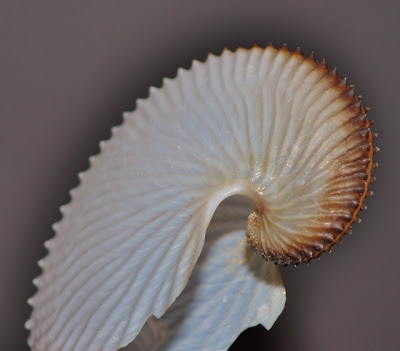
Eagle-eyed he had spotted it – argonauta argo – a Paper Nautilus shell. An extremely rare find, it is prized among collectors and renowned for its wafer thin, spiralling beauty. This was a perfect specimin- the former shelter of an unusually palagic octopus (one which lives in the open sea, not crawling along the seafloor like its lesser cousins) using its shell for ingenious bouyancey control. Over the ages this very shell has been the subject of such consternation, even Aristotle hypothesized in 300BC that the shell was used as a boat, saying the octopus must surely rise to the surface and use its tentacles as oars and sails.

It must be noted that Aristotle had a rather wild imagination, but the theory so struck Jules Verne – who also had a wild imagination – that it inspired his Sailing Argonauts which he wrote about in Twenty Thousand Leagues Under the Sea.

Before long we had arrived. The history of the Arniston was alive in this place by the sea – her weathered bits lay at rest between a view over the dunes on one side and a seaview over the town that shares the same name on the other. Yet what could have been a somber end to a thrilling day filled with historical intrigue and the beauty of nature’s creation suddenly turned lucky.

“Hey, over here”, called Robert, pointing to something in the white sand while Trigger just crested over the farthest sand dune. I could see the luminuous green from where I stood, glowing in the setting sun. It was a piece of the Arniston’s brass plating, the tiniest of little shards. “It’s a piece of the Arniston, ” Robert offered, “Take it with you – keep it in your heart.”

Saturday, February 11, 2012

The Encounter: How Harley The Brave Took a Piece of My Heart


Harley came into our lives on one of the hottest days of the summer. The heat was almost unbearable and we were out on the balcony enjoying the afternoon breeze when our landlord arrived home. While trading greetings his gaze feel upon Harley's tiny fluffed movements there in the middle of the drive. The tyres of the car must have just missed him. Not skipping a beat our Landlord scooped him up, handed him to us and said matter of factly, "Well, better keep him with you and away from the dogs."

And with that, we were on a journey.

We weren't sure just what kind of bird he was and it was a few days until we realised he was a White-Rumped Swift, one of the world's fastest fliers and one that migrates between Europe and Africa each year. From his weight, just 20 grams, we guessed from internet research he might be 10 days old, a good few weeks away from flying.

We considered the options - most resources advise you to find the nest and simply put him back. Easy peasy. Except in Harley's case the nest had been broken down, somehow. No one knew for sure, and there was only one option - to care for him until he could fly.

We searched for information on what to feed him and so on, and were soon frustrated by conflicting information on the internet. We tried to keep his diet as natural as possible - insects - which meant a daily excursion during the sunny afternoon into the nearby fields on the farm where we were living, swinging a butterfly net borrowed from the Landlord, chasing down unsuspecting locusts, grasshoppers and crickets. Ants were on the menu, too - collected at a crack in the wall that must have led to their nest and, as they spilled out of it we would squash them with our fingers, putting them into a container until the bottom was covered in a black mass.

At feeding time two or three of the poor insects would be executed, pulled out of the container by the scissors that we would summarily use to snip off their heads, legs and wings, saving only the soft thorax for Harley. It was disturbing work, especially when the body would go hopping about while the head lay wriggling on the plate, but we put this thought out of our minds in favour of the hope that Harley would fly. The bodies were ground into a sticky paste, along with a few ants, and smeard on tiny bits of scrambled egg.

Helpless as he was, he wouldn't eat this food on his own. We had to feed him. In the early days he would gape whenever he was hungry. It is an odd feeling to have a tiny creature willingly shove their throat around your finger, to feel each tiny muscle working to accept sustenance, the pink of his neck visible through the fluff of feathers.

Day after day the routine continued and Harley was full of spunk and fight, letting us know when he was hungry, which was nearly every hour at first, then every two, even overnight and knowing he needed us if he had any chance of survival we tended to him at all hours. I watched the clock nonstop - paying attention to feeding time and not leaving the house for too long at a time. Harley needed us.

Things were on the up - his energy increased as he got used to flapping his wings and exploring his little space, his talons became sharper, his wings less fluffy and more smooth, and his white markings developed, especially on his rump and along the tips of his shoulders at the start of his wings. He gradutated from a shoe box, to a packing box, and eventually to a small enclosure that allowed him the space he needed to move around in.

I spoke to him every day - telling him how brave he was, and that he needed to stay strong, and to eat more, and that before he knew it he would be flying the world's skies and back with his other bird friends.

After two weeks his weight had gone up to 36 grams and we knew he would be flying soon. I even worried that I would miss him when he was gone traveling to another hemisphere, and mused that perhaps he would come back next year on his annual migration, and how maybe, just maybe he might perch nearby and remember us.
But it wasn't meant to be.

He stopped gaping for food and never seemed to be hungry. Then the rain came. For three solid days there were no fresh insects. He seemed listless. He lost a few feathers. His weight evaporated, back down to 20 grams. Frantically we searched for ways of feeding him, finally resigning to force feeding with the use of a tiny syringe. It was horrible but at least we knew he had eaten. Eventually the sun came out again so we could hunt for his natural diet, running through the field with the net in one hand and a container in the other, trying to catch as many calories as possible.

Things started to improve. His weight was unchanged but he was energetic again - running on his tiny little feet, spreading his wings and flapping even more than before and it seemed he was on the mend.

The last night the cold front hit us. I feel asleep with him in my hands and at some point woke to put him into his bed, worried I might roll over onto him. During the night my partner checked on him, placing him inside the nest we had formed for him out of tea towls and a plastic container, trying to keep him warm. I woke before sunrise- it was 5AM. I found him lying very still and when I picked him up he tweeted, but ever so faintly.

I held him in my hands, trying to warm him but he became more and more still until there was nothing left. I held him close, crying over him, but it was done. It was 3 weeks and one day since he came into our lives. The heat had delivered him from his nest into our hearts, and the cold took him away.

I wrapped him in a cloth and placed him in a wooden box. Together we pulled at the earth and placed him in a small grave, under a tree, overlooking the sea. His tiny body is there now but his spirit is free and with it, is a part of me.

Wednesday, December 21, 2011

Please nominate Theresa Lozier in the Getaway Travel Blogging Awards


Thank you to everyone out there who has been following this blog, and especially to those that have sent me emails with a little of their own stories. It's been amazing to connect with incredible people from around the globe.

I'm writing now to ask for your help. If you like my writing, please nominate THERESA LOZIER in the Getaway Travel Blogging Awards. Being recognized in these awards would mean a lot and help me find more interesting writing opportunities.

Click on this link to get to the form: http://forms.getaway.co.za/view.php?id=500

Thank you everyone!
Sincerely, Theresa

Saturday, October 29, 2011

Sand dunes, the African Bush and Secluded Luxury at South Africa’s 5-Star Oceana Beach & Wildlife Reserve

After spending a few days on safari at South Africa’s iconic Shamwari Game Reserve, where I experienced the adventure of Africa’s Big 5 for the first time, I arrived at its sister property, the Oceana Beach & Wildlife Reserve. Positioned between the Indian Ocean and the African bush, Oceana offers guests a unique blend of luxury, privacy and nature that gives new meaning to the phrase, “getting away from it
all.”
Connected by a walkway leading through the Milkwood Forest, the seven private suites feature thatch-roofs, and stone and wooden materials that fit in with the natural environment. Benches positioned outside your door provide a place to wait in absolute stillness and quiet for the rare (and
shy) African Loerie to make an appearance. Once inside, the suites feature His and Hers appointments, from individual
cupboard space to the marbled bathsuites that waste nothing of the view.

You could be content to spend your entire stay within the comfort of your own suite, where you can enjoy spectacular East Coast sunrises from your private veranda, or even from your king-sized four-poster bed. When you want to bring the outside “in” you can do that, too – the floor-to-ceiling windows can be slid open for an unobstructed view of the land and a breath of fresh air.

Natural beauty is complimented by modern conveniences, like the flat screen television that, at the touch of a button, rises up from its hidden position from an otherwise ordinary chest of drawers at the foot of the bed. Small touches, like a personalized welcome note and a selection of complimentary South African snacks, ensure you feel like a very special guest from the start.

Oceana’s true strength is its ability to deliver impeccable service in a setting of unbelievable beauty, and its game drives, which can be arranged at any time you wish, are just another example of this winning formula. While this isn’t a Big 5 reserve, some of Africa’s most majestic and rare wildlife can be viewed here without the danger of predators. Guests are escorted by trained rangers in safari vehicles, complete with refreshments and a set of quality binoculars for each person. Use them to study the intricate markings on free roaming animals near and far – from kudu, water buck and impala to inala, blue wildebeest and zebra.

Highlights for me included a family of giraffe, including a young baby which calmly stood observing us, while we sat observing him. Then there was the endangered white rhino – which after enjoying the gaze of our cameras for several speechless moments made a sudden departure with a quick turn, click of his heels and a duck into the thick bush, leaving us with only a giant cloud of dust.

It was remarkable how such a behemoth of an animal could just “disappear” into the bush, something I’ll keep in mind the next time I think I’m “all alone” in nature!

And the final highlight for me, was an encounter with the majestic sable. Exceedingly rare, it is a beautiful sight with its arched horns and painter’s markings that frame its face in contrasting tones of stark white, black and brown.

We spotted a herd of them from a distance, and, as we bounced along the gently sloping hill to our viewing point our ranger told us how she had hand reared one of them when he was orphaned, and explained that because he had to be fed with a specially formulated milk, he had not been able to receive some of the nutrients he would have gotten in the wild, resulting in his coat becoming a distinctively lighter, copper colour compared to the rest of the herd with their dark brown coats. As we came to a stop he seemed to take notice of us, and she explained further that he did in fact recognise her yet had been accepted by the herd as part of his rehabilitation and introduction back into nature. It was beautiful to hear the love for nature in her voice and to see that such a gentle creature had been nursed back to health because of it.

At Oceana you can do the things you want, when you want – and there certainly are many options to choose between. Practice your swing on the 5-hole putting green, whale watch from the decks (June-October is the season), or find your competitive streak in the Games Room – complete with a pool table, shuffle board, and a lounge and television. Invigorate at the gym, or relax at the spa where you’ll emerge without a care in the world. Then take a drive down to the beach, accessible via a 4-wheel drive vehicle, with one of the rangers available to escort you at any time you wish.

Once at the beach you can enjoy a private lunch from the resort’s viewing platform, go fishing or take in a long walk along the dunes filled with the feeling of solitude and the sound of silence. Everywhere you look sand dunes stretch from the edge of the bush towards the sea, and each step you take seems to fall out from under your feet as you descend towards the shoreline.

This is a place that leaves you are utterly and wonderfully alone with your thoughts, free to reflect on the experience of Africa with the Indian Ocean gracing your feet and the sound of the waves in your ears. Walking at the water’s edge you’ll see a curiosity of seashells strewn out before you, and – if you’re lucky like I was – the absolute magic of wild oysters might be there for the taking!

Our ranger, visibly impressed with our find, told us with a glint in his eye how he used to walk this beach with his grandfather in search of oysters decades before. When we returned to the lodge the chef was only too happy to prepare them, serving them to us at dinner on a plate of crushed ice and fresh lemon wedges. They were some of the tastiest oysters I have ever had, complete with a champagne toast, and even the discovery of a pearl in one of the shells!

From our candlelit table I could still hear the crashing of the waves, and I knew that just beyond the balcony lie more of nature’s wonders. The cozy sounds of a crackling fire was complemented by the happy clatter of dinner conversation. It had been a day full of discovery – one I would remember forever – and as dusk fell and the stars presented themselves, I could only imagine what tomorrow would bring next.


Tuesday, October 25, 2011

Glamour Meets Style at Port Elizabeth’s 5-Star Shamwari Townhouse

Whether you travel for business or pleasure, when you find a ‘home away from home’ that’s a bit better than what you left behind, you’ve pretty much struck ‘Road Gold’. And when it comes to Shamwari Townhouse, situated in Port Elizabeth, South Africa, you get that and more.

With its curving façade, sleek lines and indigenous gardens, you get the sense from the moment you arrive that you’re in for more than a stylish bed for the night. The original structure built in 1937 and painstakingly restored to its former glory, this is an architect’s dream. It is a space that inspires the mind, and, in the truest sense of its 1930’s Art Deco-style, the Shamwari Townhouse unabashedly carries guests away to a lavish world of sophisticated glamour, luxury and grace.

An unusual offering in South Africa’s Eastern Cape, the property reflects the passion of Adrian Gardner, founder and CEO of the world-famous Shamwari Game Reserve. Themed rooms – like the Jazz Room (notable for its six-course wine pairing menu), the Piano Lounge, Champagne Lounge and Salon Privé – feature furniture pieces with curved fronts, Fornasetti wallpaper, glass chandeliers, inlaid wood, mirrors and clean lines. Each separate space is characterized by a monotone colour scheme in soft tones of lilac, mauve, jade or turquoise, offset by light and dark wood, inset black lacquer, metallic wallpaper, chrome accents, geometric shapes and clean lines.

Classic style is complemented by modern extravagance – like the feature fountain, visible from floor-to-ceiling windows in the Jazz Room, which delivers a stream of water as smooth as glass to the pool. A private cinema,

designed with special permission by the Royal Family, was inspired by the one Prince Charles keeps in his London Residence, Clarence House. Plush carpets that sink with each padded step lead downstairs to the private Dining Cellar, the only room in the townhouse to follow the Provencal style. An oversized dark wood table set with gleaming candelabras and opulent red velvet chairs overlooks row upon row of neatly laid vintages – including French Champagne along with the South Africa’s best wines – set behind glass in climate-controlled comfort until the arrival of their day of glory.

Art, sculpture and photography by celebrated local artists – including Obie Oberholzer, Jon Riodran, Bianca Plate, and Anton Momberg – hint at the unique dimensions of a modern South Africa, making you take pause, look and reflect. The visual experience of Shamwari Townhouse is complemented by a soundtrack of iconic Jazz – the Dave Brubeck Quartet, Josephine Baker and more. One almost expects to look over and see the likes of Marlene Dietrich enjoying a long slim cigarette the lounge.

Private Guest Suites feature a more contemporary design. Secluded garden views from the private patio or balcony, an en suite lounge, dining room, kitchen complete with your very own espresso machine, king sized bedrooms and an extravagant double bathroom afford the luxury of a cleverly designed space that delivers both functionality and privacy.


The language of luxury at the Shamwari Townhouse beguiles even the most travelled of guests. A reflection of an era desperate to celebrate life’s opulence after the austerity of the First World War era, today the townhouse offers guests a boutique Art Deco experience that combines exceptional design, impeccable service and modern convenience for ultimate luxury.


Saturday, October 22, 2011

South Africa’s iconic Shamwari Game Reserve – Conserving a Vanishing Way of Life, One Step at a Time

On a recent trip to South Africa’s Eastern Cape, I was invited to visit the world-famous Shamwari Game Reserve where I experienced the Big 5 for the first time.

In South Africa there are only two ways of travelling – local and luxury.

’Local’ takes you to places you never knew existed. The sights, sounds and smells that can only be discovered in the moment. The townships, where haphazard shelter is built out of corrugated iron, bricks and tyres. Places where small businesses announce themselves in spray painted letters, and where life happens on street corners to the tune of gospel, hip hop and Afro-Jazz.

’Local’ is in the colourful markets packed with goods and people, moving this way and that, in organised chaos. Where the Mamas of Africa carry their babies on their backs while they walk with sacks of maize, suitcases, firewood or other awkward objects, balanced delicately on their heads.

Then there are the gathering places for transit – trains, busses and taxis – where the crowd is a heaving swarm of mixed destination. Where you are absorbed without prejudice, bumped into, sat up against, touched. In the community of Africa, the concept of personal space is as foreign as you.

As the South Africans say, “Local is lekkar!” (roughly translated, “great”) and I have to agree, but for this trip, I was in the mood for something different.

Luxury.

Luxury travel in South Africa takes to you to the places of imagination – the places you’ve dreamed of, heard about, read about – but never knew for sure if you could ever get there. It’s the place of colonial travel tales, of dreamlike postcards, the pages of National Geographic and scenes from the Discovery Channel.

This is a world of catered sustenance, crisp linen and soft beds. A world of lifetime memories available for the taking, right then and there – of crazy experiences like shark diving, sky diving, abseiling and more. Of game drives and tented safari camps, where evening conversation is graced by the distant sounds of predators while excited dinner guests trade stories of wild life encounters, adventures and triumphs. ‘Luxury’ in South Africa is not merely a way of travel – it is a destination that is not marked on maps, not tracked on Google Earth nor charted on GPS.

It is the Magic of Africa – and I wanted to find it.

Here, the wealth of a ‘United Nations in Travel’ falls like soft rain on the sometimes harsh landscape of Africa’s most southerly nation, nourishing the ground so that it can sprout anew – with jobs for the local community, investment in the local economy, and the conservation of indigenous flora and fauna – including the Big 5, and especially the Rhino.

An endangered species, the rhino has already been rescued from the brink of extinction once before in South Africa, but now it is finding itself in dire straits once again, threatened by the chaos of fortune makers, mystics and desperate cure-seekers intent on getting one thing – the horn. Of the 20 000 rhinos living in South Africa, this year 324 have already been killed illegally for their horns.

There is a crisis in the bush, and we’re running out of time – fast.

It seems a desperate situation – but the power of conservation cannot be underestimated, nor the power of public outcry, and no organisation is better placed to help bring attention to the situation than the iconic Shamwari Game Reserve, named the “World’s Leading Conservation Company & Game Reserve” for the past five consecutive years.

Shamwari, meaning ‘friend’ in Shona, is a vast reserve of 25 000 hectares of land in South Africa’s malaria-free Eastern Cape, located along the Bushman’s River, mid-way between Port Elizabeth and Grahamstown. Once densely populated by prides of the now-extinct Cape Lion and vast herds of Cape Buffalo, Zebra, Black Wildebeest, Elephant, and Rhino, this was the site of mass hunting throughout the 19th and 20th centuries, until all that was left was a drought-ravaged, overgrazed piece of land overtaken by exotic plant species and overrun by goats, cattle, and sheep.

It was in this context that Adrian Gardner, Shamwari chairman and founder, had a vision to bring the land back to its natural state, and starting 20-years ago, he embarked upon a re-wilding project focused on eliminating alien plant species, removing abandoned wire fencing that disrupts the natural migration of animals, and building natural dams to control erosion – all to create an area where wildlife and vegetation could be successfully restored. It is thanks to his determination that visitors to Shamwari today have a rare and precious opportunity to experience an indigenous view on South Africa – the way it was meant to be.

The destination of choice for international celebrities and royalty, Shamwari is known for its accolades and awards, including Africa’s Leading Safari Lodge, and offers plush accommodation, world-class service and exceptional game viewing. Coupled with its relentless commitment to sustainability and conservation, Shamwari highlights the impact we can have on the world, for better or worse.

The truth is, Nature needs our help – and Shamwari is showing us how.

A once forlorn stretch of land is now the thriving home to five of South Africa’s seven bio-domes. The local community that once had little hope for employment is now at the heart of a healthy economy. Orphaned elephants, injured cheetahs, ill rhinos – animals that once would not have survived – can now be saved in the Shamwari Rehabilitation Centre. Big cats that were once abused and subjected to horrific conditions in captivity around the world – have now been rescued and returned to Africa where they can have a better quality life through the Born Free Foundation and Shamwari’s two Big Cat Sanctuaries. And the precious rhino – who is now under constant threat of poaching – now has a little more hope with the protection of Shamwari’s expert and highly specialised Anti-Poaching Unit.

Operating 24-hours a day, seven days a week, rhinos are tracked using micro-chip technology. The programme is the most sophisticated and respected anti-poaching outfit in South Africa, and costs millions of dollars to operate each year. While the system can do nothing to stem the demand for rhino horn, so far it seems to be working at protecting the stock of these vulnerable wonders.

And so it was, that with the utmost of respect and admiration, I undertook a journey to Shamwari Game Reserve, where I would – for the first time in all of my travels – experience the Big 5.

Arriving at the pink walls of the entrance, flanked by the flags of nations, I daydreamed about the adventures I was about to have. While exchanging pleasantries with the guard, a sign on the gate caught my eye and sent shivers down my spine with its stark warning, in three simple words:

“Danger – wild predators.”

Instantly my mind changed gears from Daydreams on Puffy Clouds to scenes from Jurassic Park, the gates eased open and before I knew it, we were in.

I surveyed the scene – it seemed innocent enough. We drove along the wide gravel road, lined by scrubby bushes and took in the view of the rolling hills as far as the eye could see. It wasn’t long before we caught sight of a parade of elephants, not far from the road. Drinking from a pool of water, they seemed to be enjoying a pause in their daily meander. Smaller ones frolicked while the larger ones stood by, their enormous size only a fraction of the presence we were feeling. Although they seemed not to pay us much notice, the energy inside the car had just hit the roof.

After a while we carried on in spellbound silence.

We would be staying at Bayethe, one of Shamwari’s seven lodges. Upon arrival we were greeted with refreshing fruit cocktails and steaming face cloths before settling in. A subdued place, Bayethe is a collection of luxury tented huts that run along a central walkway, each tucked into their own private bush. Except at the main lodge, when everyone would gather together at meal times, trade stories and meet the new arrivals, I got the feeling that this was my own private corner of Africa, and the singsong of birds emanating from somewhere deep inside the bush, was my own serenade.

Our ‘tent’ was more like a honeymoon suite with all the luxuries one could imagine – hardwood floors, a walk-in closet with his and hers appointments, a roaring fire, a plush bedroom graced by flower petals, fluffed pillows, a personalised welcome note and handcrafted nougat, a master bathroom, an outdoor “bush” shower and an indoor bathtub of immense proportion. Outside we had our own private deck and a romantic pool. Faced with the prospect of a long bubble bath followed by wine and fireside lounging, I began to toy with the idea of tucking in for the night.

Alas, I snapped out of it reminding myself I was on a mission. It was safari time.

Back at the lodge my fellow adventure-seekers were already gathering around the Land Rover like hungry vultures. We politely introduced ourselves to our game driver, Ben, and then found ourselves silently vying for the best seats. Sizing one another up, we edged into position – in as civilised fashion as we could muster, of course, yet with all the seriousness as our wild counterparts at the nearby watering hole. We needn’t have worried– they were all great seats. One by one, we took our places amongst a confusion of blankets, hot water bottles, puffy jackets and fuzzy hats. It was afternoon and the temperature would fall, along with the sun, before our return. The diesel engine humming beneath us, we traded happy glances, revving with excitement until it was finally time to set off.

We swung uphill along the wide gravel road, the dust rising behind us like rust-coloured mist. Almost immediately we spotted a group of eight giraffe, their small faces balanced on long necks, set on smaller bodies balanced on stilt-like legs. Looking simultaneously graceful and awkward, we stopped and whispered as they chewed their cud.

Thick bush pressed up against the road’s edge, parting at times to reveal small clearings and open plains. We craned our necks and squinted at the distance, impatiently hoping for another sighting while we bounced along the road, eventually stopping at the top of a ridge where we could see a herd of buffalo dotting the landscape. Looking through the binoculars the hairs on my neck started to stand on end when I got a glimpse of golden lumps, huddled in the long grass under a tree. A pride of lions, getting a last rest before hunting time. We sat in the quiet stillness, whispering and murmuring to one another. When we had all got our fill, our game ranger turned off onto a smaller passageway that would take us deeper into the wildness.

The narrow path we followed twisted and turned, and the thorns of the trees we moved through seem to reach out and tear at the canvas above our heads. Rushing through pot holes, dips and bumps, the lane sometimes vanished beneath us until we found it again in abrupt landings that threatened the wellbeing of elbows, knees, and bottoms.

Before long we came to a clearing and stopped. There they were – elephants – and they were walking in our direction. I hugged my hot water bottle closer, hoping for some sort of comfort. One elephant alone was larger than the Land Rover and all seven of its occupants alone. They snorted and probed us with their eyes, all the while pulling noisily at the bush with their elegant trunks, making loud ripping sounds with each twist. Not phased, they carried on watching us, lifting clumps of grass and dirt to their wet mouths, before grasping and ripping out more.

We waited in absolute silence – no one dared move an inch. They were so close now I could see the tiny hairs protruding from their leathery skin, which hung from their haunches like an oversized shirt that had lost its shape. Seconds stretched into ages as we held our collective breath, our eyes fastened on their eyes, while a baby elephant scuttled between the matriarch’s trunk-like legs and raspy tail, unaware that we were locked in a moment that would be ingrained in our memories forever.

Although our hearts were warm, the air now carried a chill and the sun rays began to pierce glory through the clouds. We carried on, snaking along the river until we came upon a brown hyena, the rarest kind. He looked ragtag with bristling long hair on his body but short, spotty hair on his legs – and like a celebrity who knows they’re about to appear on the ‘Worst Dressed’ list he quickly escaped the gaze of our cameras, disappearing into behind the next ridge.

In the quiet of the bush Ben’s walkie-talkie suddenly came alive. It was another game driver who had spotted a leopard, the most elusive of all the members of the Big 5. Disappointment about the brown hyena’s early departure was but a distant memory as we set off in the direction where the leopard had been seen.

As we neared we could see the Land Rover of the other game driver pulled off to the side. We slowed and approached quietly, and although we were in a flush of excitement, we spoke to one another in hushed tones. The ranger motioned to a place in the thick bush and I peered through my binoculars to see a gruesome scene – the fresh carcass of a Kudu lay balanced among the branches of the tree. Still supple, shredded muscle swayed in the breeze. Sure enough, the leopard was nearby, guarding his kill. He seemed aware of us but stayed aloof, not paying us any mind, just like a house cat that’s not in the mood. He graced us with only a view of his rump, keeping the rest of his powerful body tucked just out of sight.

It was just as well – we had seen a leopard in the most extraordinary of circumstances – we had seen more than enough.

After some time we moved off again, this time in the direction of Bayethe. Ready to get home for the night, we would shortly collide with one more encounter.

It was just before sunset. The last dusting of light fell upon the landscape, illuminating it in rich, golden hues. Daytime seemed to take one last breath as Night’s long, shadowing fingers held her in their embrace. A place in the distance seemed to glow, drawing my eye towards it and suddenly I saw them, standing quietly, gently, munching on succulents.

A family of rhinos.

I studied them closely, choosing to focus on one in particular in the waning light. Most of his face was covered in the dark shadow his great horn – just one aspect of his power but now the form of his greatest vulnerability.

He looked at me – curiously – his small, soft eye taking me in. Was I a threat? Did he need to worry?

He carried on grazing – the most powerful vegetarian on the planet – watching me from behind his mass of armour. He seemed to relax. I was an innocent tourist, and he was safe – for now.

As we turned to leave I knew I had found what I had come here looking for – the Magic of Africa, alive and well.