Showing posts with label South Africa. Show all posts

Sunday, March 4, 2012

Shipwreck & Secret Treasure: Arniston, South Africa

Renowned as an idyllic coastal retreat, Theresa Lozier discovers that Arniston’s white sandy beaches and turquoise sea harbour even more hidden beauty than first meets the eye.

“So you want to see the secret cave?” asked my host, Robert Haarburger, nonchalantely motioning to a small, dark crack in the ground. I laughed out loud, thinking he was making a joke, “Yeah, sure I do” but his look told me he was serious, and then the penny dropped. I stammered, “You mean you want me to crawl through… that… hole?” It looked tiny and I couldn’t imagine it would lead to anything but a terrifying, bat-infested, spider-riddled death. “You first” he smiled brightly, “you’re a lot younger than me.”

We were standing on a vertical cliff, one of the most distinquishing features of Arniston’s rugged limestone coastline which has, over the millenia, been sculpted to the whim of the wind and the sea like proverbial Playdough. Today it forms a series of dramatic arches, outcrops, contours, clefts, ridges, overhangs and caves.

The most famous of these is Waenhuiskrans, meaning ‘wagon house cliff’, so named because Dutch settlers believed it was big enough for an ox-wagon to turn around in. This is a reference that means little to us today – perhaps a comparison to a double-cab Toyota Hilux would be more appropriate, but nonetheless, it is a rather large space. Submerged at high tide and pounded by incredible surf in between, low tide reveals a small entrance, giving the intrepid the chance to steal a few moments in this uninhabitable space.

This is a place where the dark, dripping rocks inside contrast against the brightly lit and splashing turquoise outside – an experience that makes your heart beat with almost the same force as the crashing of the waves.
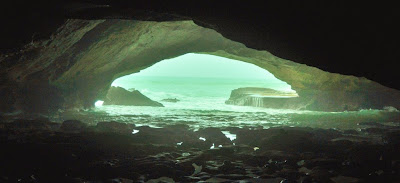
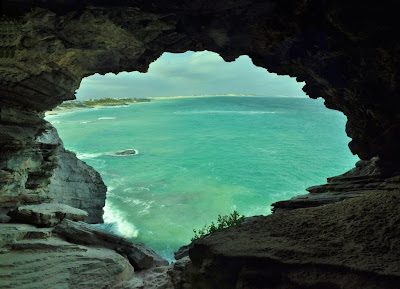
But now I was about to see another one of Arniston’s secrets, a lesser known cave which might have served as shelter to the ancient Strandlopers, or at the very least to a few jovial characters over a modern campfire in our more carefree age. Robert looked amused as I wedged myself into the hole, legs dangling, arms gripping, my feet searching for a landing. Small rocks dislodged and disappeard into the darkness beneath me. Finally I touched down and Robert scrambled in behind me. The cave was room-sized and offered a view over Arniston framed by its own ragged-edged eye. The rumbling of the waves as the sea heaved itself against the rocks below us sounded deep and powerful while the sight of birds gliding by just out of reach in the window of the cave’s opening formed a tranquil scene, all to the soundtrack of the whistling wind.
Robert Haarburger is an Arniston local – he grew up here, traveled and lived overseas, and eventually returned two decades ago, transforming property that his family owned into some of the only sources of local employment in the village – the relaxed Arniston Seaside Cottages, and the iconic Arniston Hotel. He says with the shrug of a man resigned to the temptation of his heart, “People told me I was crazy to return, but I love Arniston. No matter where I travel in the world, it always calls me back, like it has a piece of my heart.”

We clambered out of the cave and into Robert’s waiting dune buggy, which looked equipped to take us just about anywhere. Our trusty sidekick went by the name of Trigger – Robert’s English Pointer – a friendly dog with melt-your-heart brown eyes and a boundless energy that justified his name.

Trigger spent most of the day intermittently launching himself from the back of the buggy, springboarding onto my lap and out, to gallop (and I do mean gallop) just ahead as we made our way around the Nature Reserve. From the Struispunt Beacon, past ancient middens (heaps of ancient shells, bone and other artefacts discarded by Strandlopers from the Middle Stone Age… ) to the farthest reaches of the bay along a bumpy, muddy, sandy all-terrain road that eventually peeled away to reveal the windswept horizon, crashing surf, rocky coast and more of that turquiose water – Arniston offered up her little-known treasures from every vantage point.

Two-hours from Cape Town, Arniston is accessible along a finger of road that extends 25-kilometers past the closest town, Bredasdorp, towards the southern reaches of South Africa’s coast. Relatively isolated and undeveloped, Arniston is known as a coastal retreat. Set against an aquamarine sea, the village is dotted with thatch-roofed white-washed cottages, the most famous ones forming the 200-year old Kassiesbai, home to generations of villagers – in fact, the only people allowed to live there are the few that have been born there.

Two of these villagers, Connie and Byron, took some time to show me around and together we wandered the paths between the historic buildings while curious children trailed behind us like we were part of the Pied Piper’s secret envoy. They pointed out the local Craft Market and Willene’s, a restaurant where tourists can enjoy a local’s meal, along with the cottages of their family, neighbors and a few which stood empty after the passing of another generation. It was clear that they were part of a close-knit community that was more like their family.

Both were employed at the Arniston Bay Hotel – Byron was trained as a Pastry Chef and Connie a Manageress, who – like Robert Haarburger, once left Arniston for greener pastures but was eventually lured home. Gazing out over the aquamarine horizon, she explained, “I went to Cape Town for a while. It was exciting but…” she trailed off before facing me with a Judy Garland smile, “there’s just no place like home.”

Recognized as a National Monument, the sandstone fishermans’s cottages of Kassiesbai are bordered on one side by the town of Arniston and on the other side by a sea of sand dunes overlooking the site of the wreck of the HMS Arniston.

One the worst nautical disasters of all time, 372 lives were lost and only six survived when this East Indiaman ship – which had until then survived pirate attacks and eight journeys between Great Britain and the Far East – sank unceremoniously in 1815. Apparently the owners of the ship didn’t put much stock into accurate navigation and decided it would be better to save a couple of bucks than to buy a marine chronometer, yesteryear’s GPS. Traveling in a convoy of six other ships, the Arniston had to rely on them for accurate navigation. As with most things in life, you don’t really need them until you really, really do. Unfortunately for the Arniston the weather did not play along and a week before her demise the she was given a death sentence.

Bad weather struck.

Rough seas and gale force winds damaged her sails, separating her from the convoy. The storms continued. Strong ocean currents led to one navigational error after the next, and eventually the Captain fatally headed north, running all 1468 tons aground over the L’Agulhas Reef just 900-metres from shore. After a week of death row, it was all over for most within a few hours.

Today the ribs of the ship can be seen among the sand dunes, and fragments of its once proud brass-plated hull shine out in shades of weathered green to those who are lucky enough to find them. We headed in that direction as the misty, ocean air began to stick to us, cold and clammy. The sun began her descent, lighting up the clouds in shafts like it might have through the patchy sail of the Arniston on her last ill-fated eve.

The dunes rolled out before us like a Magic Carpet, undulating in the wind, while the waning light made it difficult to see where it rose and fell. Unphased, Robert kept up our speed as I held my breath, gripping both the roll-bar and my seat belt, a nervous smile permanently fixed on my face. “Wha-hoooooooo!” I screamed convincingly, trying to to quell any thought that I might be in some sort of serious danger, out here in the sand dunes at dusk, as we seemed to freefall down 45-degree angles while Robert explained, nonchalantly of course, that this was much safer than driving along the ridge of the dune. “Oh, yes!” I exclaimed, pink-cheeked and breathless, feeling more like a Yankee than ever.

We made it to the calmness of the beach where the waves had receded with the tide, leaving fields of seaweed strewn in big clumps like discarded piles of confetti. Non-plussed as usual, Robert simply drove over them. While I imagined long, multi-coloured sea-creature arms in deep shades of purple and green reaching up at the wheels like a living oceanic spider web, intent on trapping us or sweeping us out to sea, Robert kept an eye out for seashells.

It wasn’t long before he hit the brakes.
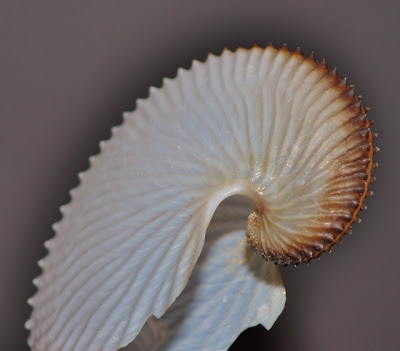
Eagle-eyed he had spotted it – argonauta argo – a Paper Nautilus shell. An extremely rare find, it is prized among collectors and renowned for its wafer thin, spiralling beauty. This was a perfect specimin- the former shelter of an unusually palagic octopus (one which lives in the open sea, not crawling along the seafloor like its lesser cousins) using its shell for ingenious bouyancey control. Over the ages this very shell has been the subject of such consternation, even Aristotle hypothesized in 300BC that the shell was used as a boat, saying the octopus must surely rise to the surface and use its tentacles as oars and sails.

It must be noted that Aristotle had a rather wild imagination, but the theory so struck Jules Verne – who also had a wild imagination – that it inspired his Sailing Argonauts which he wrote about in Twenty Thousand Leagues Under the Sea.

Before long we had arrived. The history of the Arniston was alive in this place by the sea – her weathered bits lay at rest between a view over the dunes on one side and a seaview over the town that shares the same name on the other. Yet what could have been a somber end to a thrilling day filled with historical intrigue and the beauty of nature’s creation suddenly turned lucky.

“Hey, over here”, called Robert, pointing to something in the white sand while Trigger just crested over the farthest sand dune. I could see the luminuous green from where I stood, glowing in the setting sun. It was a piece of the Arniston’s brass plating, the tiniest of little shards. “It’s a piece of the Arniston, ” Robert offered, “Take it with you – keep it in your heart.”

Friday, September 23, 2011

Win a 5-course Gourmet Dinner for Two Valued over R1000 at Overture, one of South Africa's Top Restaurants

With its million-dollar view over Stellenbosch's Helderberg Mountains, and a dining experience that’s to-die-for, most can only dream of dining at Overture Restaurant, one of South Africa’s Top Ten Restaurants and the creation of esteemed Chef, Bertus Basson. But this month you might just get what you wish for – FinePlaces.co.za is giving away a 5-course dinner for two people, including Hidden Valley wine pairings.
Tell your friends and you'll double your chances - gentleman's rules guarantee you the guest seat at the table!

There are two ways to enter: Like the FinePlaces Facebook page or Tweet this link: http://www.fineplaces.co.za/?p=1304

GOOD LUCK!

Friday, July 1, 2011

Life in South Africa

I've posted this story before... but I've had such an amazing response I thought I'd share it again. Thank you to everyone who has taken the time to write to me and share a little of their own stories with me. It's amazing to think we can connect over a few taps on the keyboard. Cheers!

A while ago I received an email from an American woman living in Asia, who is married to a South African and contemplating relocating to Cape Town. She asked for my thoughts on life here, in the long and the short term. She wondered about the things you hear in the news – the negative explanation points that seem to encompass a place, deservedly or not. Her email really got me thinking about my own experience here. I took my time to craft my reply to her and wanted to share it with you as well – I hope you’ll enjoy my candid response:

Dear friend-

Thanks very much for your mail. I’m sorry it’s taken me so long to come back to you. The truth is, your question kind of intrigued me and at first I wasn’t really sure what I would say. In a way I feel that it’s a privilege to share my perspective with you as you make this very important decision, and at the same time it is a huge responsibility to respond to you with honesty. Ultimately only you know whether moving to South Africa is a good decision for you. You might already know the answer you are seeking, somewhere deep inside.

My story in South Africa began a long time ago, in 1998, when I came here as a study-abroad student in university. At the time I didn’t know much about SA. I had heard about Nelson Mandela and apartheid and was fascinated with the idea of “Africa” – but otherwise I came with a mostly blank page, innocence, excitement and pure joy. I had always dreamt I would travel – and I couldn’t believe how lucky I was to finally board that plane and awake to sunrise over the Kalahari.

While I was here studying I fell in love. We met amidst the Southern Hemisphere’s largest sand dunes, in Alexandria. It’s a place not too far from Port Elizabeth where the dunes pile up like mountains. The view from the top makes friends at the bottom look like ants, far away, and then the blonde giants tumble down dramatically to the edges of the sea. I grew up in land-locked Pennsylvania and had never seen such harsh and abrupt beauty.

I went back to the States to finish my studies and six years went by. I had a new life but something was always missing for me. Eventually I had the chance to come to South Africa for a three-week holiday and then everything changed. I reunited with the friend I had fallen for before and we travelled together to the Transkeii on the East coast and had one of the most amazing times of my life. Those 21 days were full of turning points for me and memories that still make me smile – New Year’s Eve fireworks on a wild coast, feeling the humid tropical weather, driving through pouring rain and waving to locals who walked slowly, the same as they would on any other day, camping on a hillside next to a village where people live in huts, don’t have electricity and cows roam the beach. It was a world away, even now, and it helped me make my decision to move here, to be with this wonderful person and to carry that feeling of absolute freedom every day.

A year and three months later I moved here. It was difficult to leave my “old home” for my new one. I sold off most of my things, packed what I could, and arrived full of anticipation. I never looked back, even though this hasn’t been an easy journey. It took me a long while to make new friends and really feel like this is my home. My professional life was also full of adjustment and at first, cultural misunderstandings that proved frustrating. Soon after I arrived I personally experienced crime – something which served as the biggest stumbling block for me in adjusting here since it destroyed my sense of confidence and for a while, my free spirit. But time heals all things and now I can say I am living the life I dreamt I would live.

In the long run South Africa will present you with financial challenges – the rand does not go very far which makes international travel and every day shopping a budgeting exercise. There is talk of a national policy to weaken the rand further, making exported goods cheaper and more competitive but meaning that imports are that much more expensive. Crime is a reality that affects many people. The nation is awash in “transformation” and Black Economic Empowerment and while this is good for many it creates special challenges for white South Africans. The price of electricity is rising at a rate of 30+% each year. Quality education comes at a high price and with a good dose of competition for the limited classroom seats. The public healthcare system is troubled – there are stories in the news of hospitals having to close due to copper wire theft, babies dying due to unsanitary conditions. The president is a polygamist with five wives but still there are stories of his fathering children with other women out of wedlock – making his position as a role model in a nation awash in rising HIV / AIDS rates difficult to believe. Life in South Africa can be first world in some places, in some experiences, in some lifestyles – yet there are stripes of third world realities, struggles and corruption and the two sides cannot help but intersect at some points.

In the short term South Africa will offer you a beautiful life with wild and wondrous scenery, awe inspiring weather, joyous discoveries and memories for a life time. We’ve been to Mozambique where I slept next to the beach, snorkelled in clear warm water, ate prawns and discovered that at night there are hundreds, maybe thousands of crabs that come out and scamper along the sand. I’ve seen the greatest sand dunes of Namibia, in Sossusvlei, where the grains at the peak form a snake-like dragon highlighted by the first light of dawn. We camped in Etosha National Park and clung to our pillows while Honey Badgers snorted outside, in search of food and by day watched elephants and zebra drink at the watering hole. We walked in the zone of leopards and heard hyena at night in the distance. I’ve climbed to the peak of Monk’s Cowl in the mighty Drakensberg Mountains, 18 hours of steady walking, exhausted and exalted at the end. I’ve spent time learning to surf in the frigid Atlantic and the warm Indian Oceans. I’ve been surprised by a giant purple-domed jellyfish and later laughed at my own freak out. I am learning bits of Afrikaans and surprise locals by throwing in a word or two while talking. People are generally quite curious about me as an American and are inquisitive about life in the States and how I came to be here. I now live in Cape Town, one of the world’s most beautiful cities. We laugh that on weekends spent at home we still feel like we’re on holiday with all of the amazing things to discover. I’ve grown into a better person and learn new things every day. I miss my friends and family – and reunions are that much sweeter. I think about the things that are important to me and thank the universe for allowing me to be so lucky.

What happens to one person will never happen exactly to another we each have our own path and for that reason I think we must each make our own decisions. I hope you will make your decision carefully but believe that a dose of light heartedness goes a long way, and that sometimes the decisions made with our hearts are the most powerful ones of all. Thank you for the opportunity to share my story with you.

Wishing you all the best from the fairest cape in the whole circumference of the globe,

Theresa

Sunday, March 13, 2011

Scenic Drives of South Africa

Few things in life bring to mind such idyllic thoughts of freedom than the road trip – of driving through wide open spaces, the wind in your hair and the thought that you can go just about anywhere. Most visitors to South Africa have heard of the Garden Route, but with its stunning natural landscape, impressive rock formations and deep gorges, South Africa has even more to offer. Try one of these rides on for size and you’re guaranteed a view you’ll remember for a lifetime:

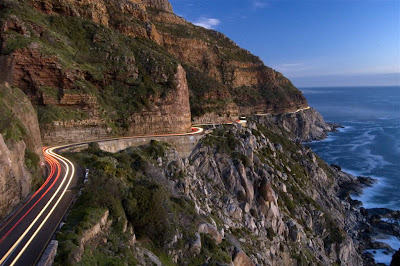
Camp’s Bay to Chapman’s Peak, Cape Town

Begin your journey just 5-min from the City Bowl. The well-maintained road descends into the arms of famed Camp’s Bay, framed on your left by the Twelve-Apostles, part of the Table Mountain range, and on your right by the sea. The road hugs the mountains and meanders south through Hout Bay, culminating along Chapman’s Peak Drive where dramatic rust-coloured cliff-faces extend above before succumbing to the crashing sea below.

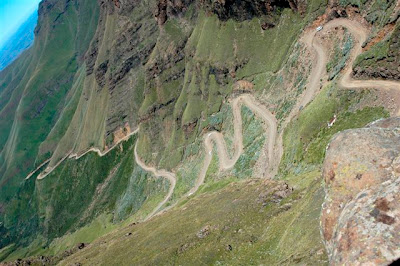
Sani Pass, Drakensberg

This drive is not for the faint-hearted, the novice driver, nor the average rental car. The landscape is stark, the road is unpaved and potholed, and don’t even think about the state of the guardrail (there isn’t one). One treacherous hairpin curve after another, this adventure road climbs up into the clouds until you reach the mountain kingdom of Lesotho where you’ll want to calm your nerves with a drink at the highest pub in Africa.

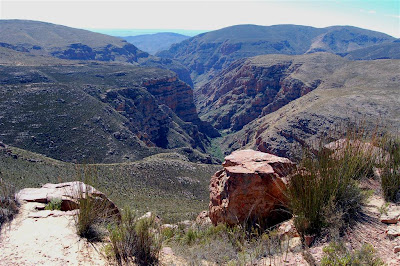
Swartberg Pass, Klein Karoo

Between Oudsthoorn's Cango Caves and Prince Albert, this unpaved road tip-toes along the mountain’s edge offering sweeping views of the shrubby Karoo-landscape far below, a gentle welcome before it takes you on a journey of secrets, bobbing and weaving its way through canyon rockwalls as old as fossils, giant proteas that flower pink and yellow in season, and endless varieties of the fynbos so unique to South Africa.

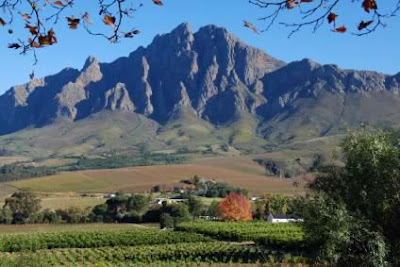
Route 62, Western Cape

Rolling vineyards, tidy farmhouses and quaint country villages give way to the dry openness of the Karoo between Ashton and Oudsthoorn on this scenic alternative to the N2, dubbed the longest wine route in the world. On a summer’s day the heat along this route rises in shimmering waves – if it’s too much, take one of the many roads heading south towards the sea where you might be lucky enough to find a cooling waterfall bursting from the craggy mountain face.

Seweweekspoort, Klein Karoo

The lines in the jagged rock walls that line either side of this narrow road reveal the crushing tectonic power that formed them – vertical lines slope to horizontal and back again. Hues of red, orange and yellow blanket the space. In the quiet of centuries, one can’t help but think back to the days of pioneers, when this keyhole through the seeming impenetrable mountains provided a merciful escape from the hardships of the interior.

Wednesday, November 10, 2010

Seeking Chenin’s Serious Side

South Africa plants more Chenin Blanc than any other grape variety and production levels here are the highest in the world, yet she carries the stigma of unsophisticated bulk wine and many consumers overlook her true potential as an elegant gem. But Chenin Blanc’s struggle for recognition isn’t over yet and her unsung story is complete with champions like Ken Forrester set on changing the odds.

The humble Chenin Blanc grape is a curious character. Something like the quiet girl at the party, she has all the grace and sophistication one could want for – yet she fades into the background next to the glitz and glamour of her outspoken cousins Chardonnay and Sauvignon Blanc. A walk into an average wine shop confirms her small pool of friends – bottle after bottle, other wines greet you at the door and only if you make it past their bells and whistles, seeming to catcall to you from the shelves as you walk by, will you find poor little Chenin tucked away in some small corner – sometimes overlooked and mostly underappreciated.

There is of course a reason for this ugly-duckling status – until a few decades ago Chenin was used to produce the bottom-of-the-barrel for the down-and-nearly-outs of society. Her history in South Africa started out innocently enough – Chenin was among the very first vine clippings planted by Jan van Riebeeck in 1655 – but the winemakers of the day had a fairly poor knowledge of viticulture, allowing the vines to grow like weeds and produce generous harvests of grapes that had little similarity to the complex quality and concentrated characteristics of Chenin when yields are low. Adding insult to injury, basic winemaking materials like oak barrels and fining were not readily available in the Cape, meaning that Chenin Blanc wine was what today we call plonk – it might have even made that sound upon landing in one’s glass – but let’s leave that topic for another time. It was so unpleasant that the officers of the Dutch East India Company wouldn’t dare touch it and only the working classes would.

But in 1806 a funny thing happened – the British occupied the Cape. I say this was funny not in the hilarious sense, but in the ironic sense. At war with France, the English Empire was desperately cut-off from the trade of French wine and to substitute they began exporting Cape wine to the world. The demand was so great that Cape wine production increased by ten-fold and the British were soon pumping millions of litres of plonk to their unsuspecting kinsmen everywhere. This surely must have hastened efforts to kiss and make up with France. When a treaty was finally signed in the 1860’s the bottom fell out. Alas, the party was over and like a discarded mistress the Cape wine industry was left holding the bag.

Then a pivotal question presented itself – just what to do with all that wine? Eventually a decision was taken to distil it into brandy - a process that yields one litre of brandy for every five litres of wine. In a way Chenin Blanc’s versatility rescued the industry from bankruptcy but this didn’t do much for her reputation since the quality of brandy, known as “witblitz” or “firewater”, was even worse than plonk wine. After this Chenin’s fate was pretty much sealed and until a few years ago no one would give her a second look let alone believe in her potential for elegance.

But did you know that a South African Chenin Blanc, properly made today, rivals the finest examples in the world, even those from Loire Valley, France where the grape originated? And just like any good underdog story Chenin Blanc has her champions – her knights in shining armour – who fight to change her reputation from one of ill repute to one of true stature. People like Ken Forrester discovered her potential before most in the industry, and even started the Chenin Blanc Association as a way to both elevate quality and change perceptions.

Discovering “diamonds in the rough” is something of a pastime for Mr. Forrester. When he decided to move from Johannesburg to Stellenbosch he found a new home for his young family – not just any home, he bought a derelict structure through public auction that had been standing vacant for years. There was no roof, no electricity, and evidence of vandalism was all over the place - sounds like a real charmer to me. But what do I know? As it turns out, his instincts were spot on – this historic Cape Dutch homestead was built in 1694, part of a farm originally granted in 1689 and today this manor home has been restored to its original glory. Besides his passion for Chenin Blanc, Mr. Forrester considers Pinotage to be another unsung story and is intent on revealing its true potential as a wine with structure, one that can even be confused with classic Burgundy, if it is kept in the barrel and aged in the cellar longer before its release. He makes a case for a change in industry standards to better inform the consumer about the care that goes into developing a wine, to encourage both craftsmanship on the part of the industry, and informed appreciation by consumers. With vision like this it’s not hard to imagine his passion for Chenin Blanc paying off – and in fact, it is already starting.

Ken Forrester wines have been recognized globally and served at gala events, including Nelson Mandela’s 85th birthday celebration. The democratic offering comes in three tiers – a value, estate, and premium range – so there is something for every occasion and every wallet. No matter which Chenin Blanc you choose, according to Wine Spectator the entire offering ranks upwards of 86-points– a nod that they are truly outstanding varietals. Best of all the 2009 Forrester Meinert Chenin (FMC) earned a 92-point rating – on par with some of the best that France can offer, albeit at a decidedly more welcoming price point.

With such a successful track record perhaps Ken Forrester has struck onto something significant – in a highly competitive global market why try to compete with the Sauvignon Blancs and Chardonnays of the world when they’re already surrounding us with their fame, calling to us from every aisle shouting “4-stars” this and “double-gold” that. At the end of the party, aren’t they just more of the same, like so many wilted flowers? When Chenin Blanc is so well suited to the South African climate and has the potential as a niche offering worldwide, why not set our own standard? Perhaps Chenin Blanc is our lady in waiting after all. Funny thing is, she’s been here all along. Funny not in the hilarious sense, but in the ironic sense. If only we would notice.

Monday, October 18, 2010

Glitzy, Girly Glamour at the House of J.C. Le Roux

I love champagne, cap classique, cava, prosecco, spumante, sekt and sparkling – we have different names for it in regions all over the world, but however you say it, I love bubbly. I love the ritual of opening the bottle – of peeling away the foil seal, like golden wrapping paper, of gently turning the wire safety, finally revealing the cork. I love that quiet moment of anticipation before turning the cork until it explodes into my hand, and the vapour that whispers out of the bottle before a delicate pour into an elegant champagne flute, and that special “cling”. I especially love the guilty pleasure of opening a bottle just for me – champagne-savers, those ingenious little bottle sealer contraptions that let you enjoy your bubbles on more days than one, are a wonderful invention.

Perhaps the champagne-saver is a symbol of the growing popularity of bubblies everywhere. No longer reserved for uber-special occasions like anniversaries or proposals, these days I find myself enjoying it with friends more often – perhaps because it’s Friday, or because we feel like a bit of girly exuberance. And why not? There are many wineries producing quality options at a price point that makes celebrating for no particular reason completely accessible. In a way, these producers are democratizing the idea of bubbly – bringing the attributes that we associate with this drink, like luxury, exclusivity and sophistication – to ladies of today at a price they can palette while lunching on sushi and looking at the world through rose-coloured designer sunglasses.

The House of J. C. le Roux, part of a historic farm established by French Huguenot Jean le Roux in the 18th century, is one of the wineries changing the marketplace in South Africa today. Exclusively dedicated to the production of bubbly, including the award-winning Pongracz label, J.C. le Roux offers a sparkling and Cap Classique range that is priced to suit just about any occasion. Placed on one of Devon Valley’s rolling hills, you’ll find it at the end of an ambling road that takes you through the countryside past dams, vines, and under the shade of sprawling trees. It feels a world away and is certainly worth a special trip. Most importantly, don’t forget your gaggle of girlfriends. While men certainly can (and should) enjoy the experience, this is a wine tasting that has been especially designed with ladies in mind.

As testament to this, as my friends and I were arriving for a recent tasting we were greeted by the sight of a group of giggling ladies, dressed in pink and floral dresses, who had stopped their car on the side of the road to pose for pictures with the J.C. le Roux entrance sign. As we approached the tasting room we noticed yet more ladies, lounging in the sun next to the water feature, beautifully packaged bottles of MCC decorating their feet. Upon entering we were swept away by streaming chandeliers, made to look like strings of bubbles floating up to the ceiling, a decadent looking pink and grey vintage-print lounger, and individual tables set for relaxed and semi-private tastings, complete with pink tablecloths and rows of gleaming champagne flutes. It was like we had arrived at the VIP section of a secret ladies’ society.

We had our choice of the MCC tasting or a mix of MCC and sparkling wines, plus the added pairing options of sorbet or the “Sweet Delights” selection. We unanimously chose a tasting of MCC range paired with sweet delights – decadent cubes of dark chocolate nougat, rosewater Turkish Delight, vanilla fudge, and more. It was utterly indulgent and worth every bite.

Halfway through we were invited outside to witness a sevrage bottle opening – a traditional technique that employs a sabre to swipe the lip of the bottle, making a clean break in the glass that separates the bottleneck from the lip, a sort of “beheading” that leaves the cork still intact in the bottle top that falls to the ground. History tells us that Napoleon’s cavalry used this method just after the French Revolution to kick-off the celebrations of many victories across Europe. I can’t think of any other tipple with an opening method as show stopping as this, yet another display of the absolute decadence bubbly brings to the table. It’s not just a drink, it’s a glass of joy. Perhaps this is why we love it so much – it takes us back to the days of pomp and circumstance, the feeling of royalty and the pleasure of very special celebrations. Did I mention I love bubbly?

  • Where: The House of J.C. Le Roux
  • Ambiance: Glitzy, girly glamour
  • Hours: Mon-Fri 08H30 – 16H30; Sat (Nov-April) 10H00 – 16H00, (May-Oct) 10H00 – 15H00l; Sun (Nov-April and Public Holidays) 10H00 – 15H00
  • Address: At the end of Devon Valley Road, Stellenbosch
  • Tel: 021 865 8200
  • Various tasting options priced from R30 per person

Sunday, September 5, 2010

Hermanus. Holidaymaking with Gentle Giants

It’s a sunny Spring day and the sky is full of tall, puffy clouds – the kinds that are full of contours, move slowly and cast shadows as big as the mountains beneath them. I’m sitting on the rocks next to the sea taking in the view. The calm waves are gently lapping below and seagulls are gliding above on the gentle breeze. I’m daydreaming, wandering off towards No-Place-In-Particular, somewhere in my own private bubble. Then a startling noise shakes me out of my head and back to the shoreline – a loud blowing of sorts, just a few meters away. My gaze lands on a place in the water where a puff of smoke still wafts through the air – “No, not smoke,” I think – “it’s the breath of a whale!” And now as if on cue, the view before me comes alive with sounds and a flurry of activity. The wind picks up, my heart rate, too. The birds are diving and calling their seagull screeches, tickling the inside of my ear drums. Somehow the swell of the water seems more intense and as I excitedly walk closer towards the edge of the rocks to see better my steps feel quick and unbalanced. Off in the distance a pod of more than ten dolphins sets course in a storm of splashes and acrobatic breaches and right in front of me, seemingly appearing out of the proverbial woodwork, are at least five more slowly moving whales, waving their tails and sending puffs of damp, warm air through their blowholes. I feel like the scene has been here the whole time, yet it’s only just come into focus – like through sitting still long enough and staring into the distance my eyes have just clicked onto the secret code.

I’m in Hermanus – one of the best places in the world for land-based whale watching. The Southern Right Whale is an annual visitor between June and November, when they come from the chillier waters of the Antarctic to mate, calf and rest – a “whale holiday” I guess you could say. Seeing them in person makes it easy to understand why they are known as Gentle Giants – on average they weigh 40 tons (that’s more than 30 mid-sized cars) and measure up to 15 meters (50 feet – about four classic Cadillac Thunderbirds, lined up edge-to-edge) long! Of course when seeing them from the shore you know you’re only seeing the tip of the iceberg.

A perfect whale watching spot at Hermanus’ Old Harbour is Bientang’s Cave, an unusual restaurant at the base of a rocky cliff on the water’s edge, set into an enormous cave – apparently named after the last Koi Strandloper known to have lived in there at the turn of the 19th century. This little bit of historical intrigue is in itself enough to make me want to give this spot a try. Admittedly, the food isn’t “to die for” (we stuck to the simpler fare and found our burgers to be over-salted and the chips to be stale), but the unique setting at the entrance to a cave where diners can greet whales from their tables over lunch, truly is. Plus, with a man-sized fireplace blazing and fuzzy throws to keep you warm on chilly days, the management has done well to create an unforgettable experience.

Bientang’s Cave

  • www.bientangscave.com
  • Located below Marine Drive, 100m from Old Harbour
  • Tel: 028 312 3454
  • Email: bientang@whalemail.co.za
  • Serving Breakfast and Lunch between 09:00 16:00, weather permitting
  • Dinner by prior arrangement

Saturday, July 17, 2010

American wine tastings can be bitter

OK, so I am an American and have been living in South Africa for over four years. Today I spent the day enjoying the Cape Winelands and, just as I have in the past, happened to bump into a few American tourists. First, let me say how fantastic it is to see my fellow countrymen enjoying this corner of the world - well done, for only so few of us ever make it out this way. Second, at the risk of sounding like a foreign-wannabe-snob, please indulge me as a give out a few hints to my fellow countrymen at how to fly a little bit more "under the radar" when touring abroad.

OK, before I proceed, I can feel it - you're already thinking, what is she talking about, she's one of us?! And before you think too far down that path, let's be honest with one another and face an unpleasant truth. Whether we want to admit it or not, we all know those stereotypes of "the loud annoying American tourist" usually clad in white Reeboks with fanny pack in tow? "Yes!" you're thinking, "so 'not' one of those!" And thankfully, it's true. A lot of Americans in Africa are not dressed that way - instead we wear safari gear and expensive photographic equipment, and unfortunately, the 'annoying tourist' is not always defined by wardrobe choices.

Anyways, I digress. If you should perhaps find yourself in the Cape Winelands, here are three tips on how to fly a little more under the radar - you'll have a better chat with the people around you and maybe get to know the place a little better, too:

Tip #1 - if the volume of your conversation exceeds the volume of all of the combined conversations around you, notice it and consider speaking just a little bit more softly

Tip #2 - if you have finished your wine tasting and are ready to purchase a few of your favourites, yet find that the person who was attending to you has started to chat with the people around you - perhaps wait until the chat has concluded, or better, join in yourself, rather than interrupt the chat to insist on "ordering" your bottles right now. There is a laid back vibe in the tasting rooms of SA and people are not really accustomed to taking abrupt orders - rather chill out and enjoy your time, what's the rush in any case?

Tip #3 - if you really need to know the price in dollars rather than rands before you make your purchasing decisions, to determine whether the wine is a "good deal" or not, rather talk quietly among yourselves and bear in mind that the people working in the tasting rooms earn meager salaries and live practically at the bread line. Whether you're rich in America or you're just an Average Joe, you are living at a standard way beyond most people in South Africa and a little tact will go a long way.

Saturday, June 19, 2010

Ayoba turns to Eina – South Africa’s World Cup Dream is Crumbling

Bafana Bafana, South Africa’s national soccer team, is ranked 88th in the world and of the 32 teams participating in the Fifa 2010 World Cup, only one team (North Korea) – is ranked lower. Yet even against terrible odds South Africans have held hope that their team will win the tournament and even the President, Jacob Zuma, has said publicly that he has “great faith” that the team can win the Cup for the nation. Perhaps it is the euphoria of playing host to the World Cup that has imbibed this child-like belief that a win is possible – like the battle between David and Goliath might play out again, or that the magic of a Sangoma – a traditional African witchdoctor – will transform this unlikely dream into reality.

There is a feeling that this is South Africa’s time – that somehow the decision to bring the Cup here has enabled the country to be finally born anew, washed of the scars of its apartheid past, freed for from the discomforts of poverty, released from the animosity between classes, its people finally united in pride and overwhelmed with jubilation – if only for a month. A feverish energy on Opening Day became inescapable – it was already apparent that the day would be filled with excitement, but this was an upwelling of large proportions and caught some off guard. Businesses planned to remain open, mostly for half-days, but the mindset of employees everywhere was on a single track – focused on the first match, made evident in the sea of green and gold jerseys that almost everyone wore to work that day – ayoba (amazing) the World Cup was finally here.

South Africa ended its first match in a draw – but the performance of the team was strong and so was the sound of the vuvuzela, a triumphant noise of support. Day by day the efficient machine of the Cup carries on operating relatively smoothly and news headlines echo a collective sigh of relief as the nation proves itself to the world, that yes – we can do this, and everyone nods in agreement, well done to South Africa. But after South Africa’s second match – a loss and a disappointing show of skill – it became evident that the euphoria is starting to wane.

Just over one week into the tournament, Bafana Bafana now stands with one of the worst host nation performances in World Cup history yet it will need to defeat France – a former world champion and a true Goliath – just to stay in the game and proceed to the next round. The buzz of the vuvuzela is going softer now, eina (ouch), Bafana, eina – the feeling now is unsettled, tense, afraid of what might happen in the next match – the last chance. Bafana, the nation’s heart is hoping and crying for you.