
Even if you have limited time, the Mother City offers cosmopolitan culture, historical interest, and a breathtaking landscape.
I am standing on a windswept beach, kilometres of pristine white sand spread out before me and the road along one of the most beautiful mountain drives I had ever experienced up above me. The waves are rolling in, forming aquamarine lines, and with the sun shining I’m revelling in the view and thinking what an amazing place this is, one of the most beautiful places on earth, and how lucky the people who live here are to be able to soak up this majesty every day. That was more than ten years ago – I was a university exchange student from the United States and was privileged to visit South Africa for the very first time. I spent six months in in the country and during that time only a week in Cape Town, but the impression it made on me was timeless.
It turns out I wasn’t the first to be mesmerized by Cape Town’s beauty. Beguiling seas, neatly laid vines and the unmistakable view of Table Mountain – Cape Town is positioned in what Sir Francis Drake declared in 1579 to be the “fairest cape in the whole circumference of the earth.” So renowned as one of the world’s most beautiful places, visitors from faraway lands have been arriving in Cape Town for centuries to experience the contrasts of a bustling, modern city that is framed by a natural amphitheatre, characterized by a distinctly African-European vibe, and within driving distance of world-class beaches and vineyards.
With all this splendour, it’s hard to believe that in the 16th century this corner of the world was of little interest to anyone except for its functional purpose as a refuelling station for sea-weary ships travelling the trade routes between Europe, India and the Far East. It wasn’t until 1652 that the Dutch East India Company (VOC) established the first permanent European settlement in South Africa. Thanks to the VOC’s free burgher policy, whereby married men were released from their contracts and given farms of their own to cultivate, more and more people made the Cape their permanent home and it quickly outgrew its original purpose as a simple outpost. The move towards permanent settlement by these early settlers had an indelible effect on many aspects of the Cape culture, the extent to which was probably unimaginable at the time and with all the cues from the past, it’s hard for me to wander the streets today and not imagine what it must have been like back then.
Evidence of Cape Town’s early beginnings are scattered throughout the city centre. The most obvious beacon of the past is the Castle of Good Hope, a pentagonal fort with thick stone walls surrounded by a moat, smack in the middle of town, opposite the busy transit centre. Private functions are sometimes hosted at the long banquet table, the same one the highest ranking officials once dined at and whispers of their conversations colour the mood of the room. Pretty Victorian buildings line Long Street, which buzzes with energy day and night. The cobblestone of historic Greenmarket Square has seen its share of change, once a marketplace for slaves, fruit and vegetables, it’s now home to a thriving crafts market lined with trendy eateries. On nearby Adderley Street a statue of Jan van Riebeeck, the founder of Cape Town, stands firm watching over his legacy in the midst of the traffic. Around the corner part of the original Company’s Garden, planted in the 1650’s to supply fresh produce to passing ships, welcomes visitors with tree-lined paths, more than 8000 species of plants and South Africa’s oldest museum – home to a 117,000-year old fossilized human footprint and rare stone artworks of the San people. Visiting the iconic Mount Nelson, a luxury hotel founded in 1899, I felt what I imagined to be a sort of colonial déjà vu while enjoying a decadent Afternoon Tea, lounging in wicker chairs with friends under lazy ceiling fans and taking in the sounds of the Grand Piano serenading the room. Cape Town City Hall, the site for Nelson Mandela’s first public speech after his release from prison in 1990, was built in 1905, designed in the style of the Classical Revival, and built almost entirely from materials imported from Europe.
The overseas influence in Cape Town is made clear by its impressive buildings which range in style from traditional Cape Dutch and Victorian, to trendy Art-Deco and Post-Modern, interrupted in places by the local and now iconic shanty towns of multi-coloured corrugated iron. The diversity of the city’s architectural landscape is just one example of its cosmopolitan heritage. The ancestry of Cape Town’s people demonstrates its diversity even more dramatically, starting with the city’s establishment by the Dutch VOC whose employees hailed from Holland as well as Scandinavia, Russia, the UK, France, Switzerland, Germany, India, Java and China. The British also had a strong cultural influence when they took over the colony in 1795. The slave population, having wide-spread origins in Madagascar, Mauritius, Ceylon, India, Malaysia, Indonesia and southern Africa also contributed to the diversity with the result that today, Cape Town “locals” are not a homogenous group and bring an eclectic mixture of culture, customs, religions, language and food to the multicultural texture one can experience in the city.
Cape Town visitors can have a first-class experience on par with competing destinations all around the world. Spend an afternoon wandering around the Cape Town Harbour, now the Victoria & Alfred Waterfront, exploring some of its 450 shops and more than 80 restaurants, set against a dramatic view of Table Mountain. Since 1860 this has been a centre of colourful activity – a trading place, a fish market and an everyday bazaar. If I spend an afternoon wandering the waterfront I can imagine the sounds of the ships back then, the sight of activity set against the backdrop of Table Mountain and the sounds of people who must have spoke, sang and shouted in a multitude of languages. To me it feels as if the thought of these things might be carried on the breeze from some other era. Yet the breeze is not one from yesteryear. The legacy of the harbour’s history lives on today – with throngs of locals and visitors, hundreds of shops selling the best the world has to offer, local craftsmen selling the unique products of Africa, and restaurants serving the cuisine of the world.
For a beautiful view just outside the city bowl you can take in the sunset in trendy Camp’s Bay – the Grand Cafe has an upstairs bar overlooking the beach and offers seductive-shabby-chic decor and live jazz music to carry you away to some other place. Enjoy dinner at The Roundhouse, a historic manor established in 1786 set high up in the hills with a commanding view, sophisticated French fare and one of the best wine pairing menus in town. If you have a really special occasion to celebrate, take a short drive to the beautiful Constantia Valley to enjoy dinner at one of the world’s best restaurants, La Colombe at the Constantia Uitsig Wine Estate, ranked 12th place in the San Pellegrino 50 Best Restaurants of the World Awards 2010.
If you need a pinch of reality after feeling too much like a celebrity, not to worry – one of the best aspects of Cape Town is the truly authentic and vibrant encounter visitors can have with the local “salt of the earth” way of life. Kalk Bay, just south of the city, is an artsy village full of antique, book and bric-a-brac shops as well as small cafes and restaurants. Visit the fully functioning harbour where you can see real-deal fishermen return from a day’s work dressed in colourful rubber overalls, cigarettes in hand, their boats laden with the catch of the day. The scene is a lively one as on-lookers crowd the water’s edge and fish to be sold are tossed from the boat, one by one, onto the pavement. Nearby Kalky’s is a local fish and chips institution serving up casual deep fried fare – oily, salty and definitely worth the indulgence. While you wait in the queue you might catch a glimpse of talented Zimbabwean musicians who energize the crowd with the rhythms of West Africa – a mix of jazzy, funky, Afro-beat – singing and dancing to the tunes of handmade xylophones, cow bells and drums. Toes tapping, you can’t help but smile at the music, the unique experience and the beautiful scene overlooking False Bay, buttressed by sharply rising sandstone mountains.
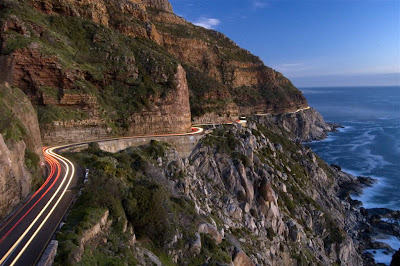
The Table Mountain Range defines the Capetonian landscape, starting with the iconic Table Mountain plateau and the natural amphitheatre it forms around the city bowl. Take the Cable Car to the top for an unforgettable view of the city below. Extending 70-kilometers south of the city, the range is punctuated by the green of the Kirstenbosch National Botanical Gardens, a national treasure and UNESCO World Heritage Site, and blanketed by the neat vineyards of Constantia, where world-class wine has been made for the likes of Napoleon for more than 300 years. The Twelve Apostles section frames Camp’s Bay on the Atlantic side and a hike up to the top of Lion’s Head provides a stunning vantage point with 360-degree views of the city and coastline. No trip to Cape Town would be complete without a drive over Chapman’s Peak, a spectacular 9-kilometer winding road set on the edge of dramatic cliffs between Hout Bay and Noordhoek. Dressed by the ribbons of pink and orange clouds at sunrise and glowing in hues of warm red tones at sunset, the drive offers some of the most impressive views anywhere in the world. After experiencing it the first time it made me dream of what it would be like to live here, if only it was possible.
After traversing Chapman’s you can follow the range to the southern-most point in the Cape Point National Park and brave the whipping wind for a view of the original lighthouse. This is the very last point of the Cape of Good Hope, extending out into the pounding waves – the same place where so many sailors of years past made that last, anxious turn north on treacherous journeys towards safety and home. Here the mountain range looks battered but resolute, as if it’s impermeable to the weather’s worst tantrums. As I stand at the edge of the peninsula, now a Cape Town “local” myself, I can imagine that the last gnarled knuckles of the mountain range stand tribute the tenacity of the people who settled here so many years ago, who imparted a legacy that I’m now a part of and that is still unfolding today. It’s this legacy that inspires the feeling one has here – that during the time you spend here it can take you someplace “then,” someplace “there,” and right here – in Cape Town – now.
For more information:
· Castle of Good Hope, www.castleofgoodhope.co.za
· The Company’s Garden, www.capetown.gov.za
· South African Museum, www.iziko.org.za/sam
· Victoria & Alfred Waterfront, www.waterfront.co.za
· Table Mountain Aerial Cable Car, http://tablemountain.net
· Kirstenbosch National Botanical Gardens, www.sanbi.org/frames/kirstfram.htm
· Chapman’s Peak, www.chapmanspeakdrive.co.za
· Cape Point National Park, www.capepoint.co.za
· Mount Nelson Hotel, www.mountnelson.co.za
· Grand Cafe, www.thegrand.co.za
· The Roundhouse, www.theroundhouserestaurant.com
· La Colombe, www.constantia-uitsig.com


 Posts
Posts

