Saturday, June 4, 2011

Newton Johnson's Dance with Pinot Noir

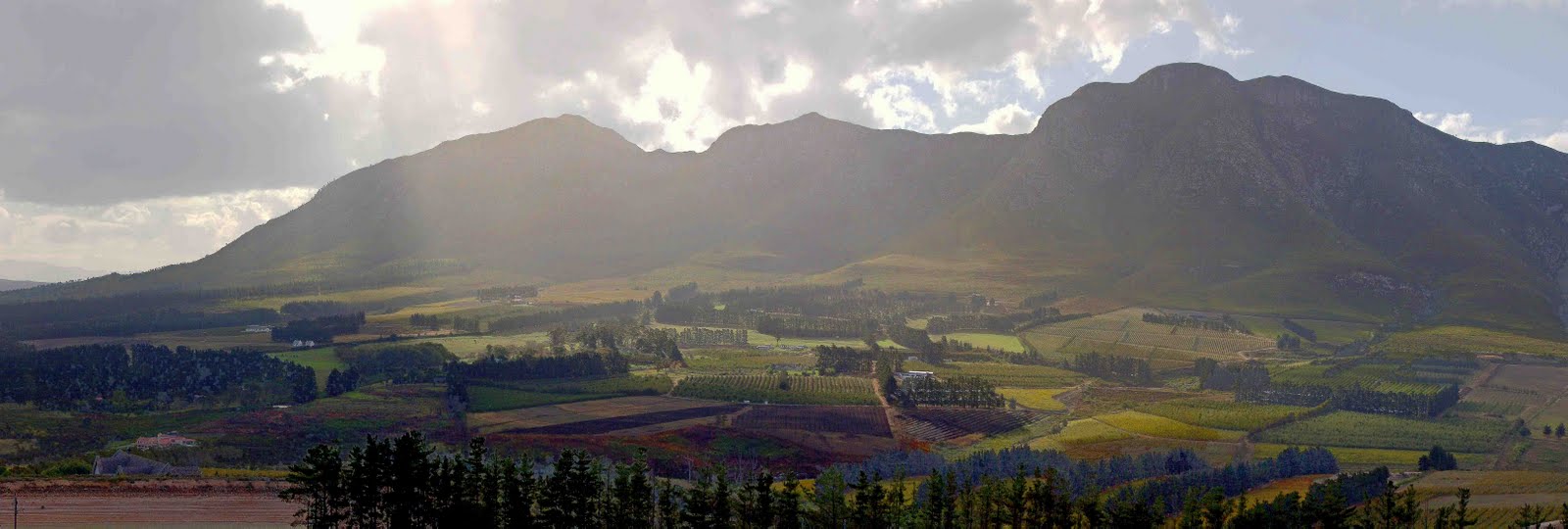
For Pinot Noir enthusiasts, the Hemel-en-Aarde Valley near Hermanus is like the Garden of Eden with more award-winning Pinots made here than any other place in South Africa. This is a true feat considering Pinot, known to some as the “heartbreak grape,” is the most difficult variety of grape, presenting challenges both in the vineyard and in the cellar. The climate of the valley plays an obvious role in the success its wine estates but I wondered if there wasn’t something more to the story so I spent an afternoon chatting with two of the Valley’s most renowned winemakers, Gordon and Nadia Newton Johnson.

From the start of our chat it became evident that Pinot Noir has captured not only their attention, but also their hearts. The couple spoke passionately, describing it as finicky yet elegant, beautiful, soft and expressive of the terroir where it is grown.

Nadia: “Once you’ve worked with Pinot there’s no turning back – you either fall in love with it or you...” Gordon: “... or you don’t understand it and push it aside.” Nadia finishes, “You just decide, ‘no’. But if its grabbed you – that’s it.”

Pinot’s expression of terroir is the one characteristic the Newton Johnson’s focus on the most, acknowledging that terroir differentiates their Pinot from others produced in the valley:

Gordon: “I think we’ve gone further to discover what Pinot will do on soils within the valley. There are different expressions between the Pinot that we’re making compared to what other wine estates in the Valley are making.” Nadia continues, “Clay soil holds a lot of nutrients and iron – it almost forms the backbone of the wine, gives it a dark, bigger kind of structure. But our soils are a little lighter, not as much clay. As soon as you take Pinot to lighter soils it becomes more fragrant, almost prettier, more beautiful. I think that’s where we are with our Pinots.”

Not only is the couple single-minded about their passion for Pinot, but also towards their hands-on approach to winemaking:

Nadia: “Sometimes people don’t understand two winemakers. When it comes to the styling of the wine we make those decisions together. Gordon, “We’re interchangeable.” Nadia, “That’s the thing – we’re so interchangeable. Between the paperwork and whatever work needs to be done in the winery it doesn’t matter which one of us does it. And we actually do the work physically ourselves – we believe that all those little bits that you put in make the difference between making a great wine or just a good wine.”Gordon: “Some of our wines are expensive, we’re getting more expensive. We feel we’ve got to be hands-on to maintain that level and take it further. We’re not just winery owners, we are wine makers. We always want to be that – we always want to have that connection with the winery and the vineyards.”

Thinking of the future, the couple are focused on developing more sustainable processes on the farm, like water conservation, and are moving away from the use of artificial influences like pesticides, fertilizers and added yeast. Although more challenging, they prefer a more natural approach which they believe will positively impact the soils in the long term, and help create an even more unique expression of terroir in their wines.

Gordon, “Water is a big part of sustainability, and we have a whole water treatment plant here. It takes 9 litres of water to make 1 litre of wine, so any waste water we create, we recycle it and put back into the water table. We also keep away from pesticides and prefer to treat our insect pests biologically with the release of natural predators, like Lady Birds and wasps. We’re also moving away from synthetic fertilizers – and are moving towards using the waste on our farm instead. These are all small steps towards becoming more sustainable.” Nadia, “We need to keep our soils alive and strong – that’s the most important thing. And as we become more sustainable we have noticed a major change in our wine – it makes us more individual. It’s really amazing to see how far you can take it – to see the qualities in the soil that can be expressed by a wine.”

It was an absolute treat to be able to spend time getting to know the Newton Johnsons. The key to their success seems to lie in their passion – passion for Pinot, for what they do, for preserving the land for another generation. If Pinot is a heart-break grape for some it’s certainly not for the Newton Johnsons – for them it’s a love affair, and so it’s no surprise their wine has seen such success. After all, it’s handcrafted with love – and anything made with love tastes better.

Newton Johnson is located in the upper Hemel-en-Aarde Valley just outside Hermanus on the R320. Stop in for wine tasting & buying, or have lunch at the stunning Heaven Restaurant with to-die-for-views of the valley. For more information, visit www.NewtonJohnson.com

Wednesday, April 27, 2011

Country Life and Everything Nice

Whether you’re an equestrian, an epicurean, or an urban escapee – getting away from it all in Noordhoek gets you more than what you started with.

I’m standing in a curious place – a place like no other in the world. A bold statement, I know – afterall, none of the usual excitements exist here. No dazzling city lights, shopping meccas or restaurant rows, no glitz nor glamour. Yet it’s precisely in this emptiness – in what is not here – that this place gains value. It’s a place with an abundance of that curious country feeling – that something that ticks inside of us in the face of long sandy beaches framed by bushveld, dunes and a milkwood forest. This is a place where the wind has a way of ruffling your hair and carrying any form of status away like so many grains of sand, and where the excited thrill of urban exultation peters out like a tiny stream in the face of the ocean’s vastness.

This is Noordhoek, a small corner on the fringe of cosmopolitan Cape Town – overlooked by some, passed through by others. For the rest of us, the local’s term “Noordhoeked” has meaning. Only 35-minutes from the centre of Cape Town, just getting here is a spectacular journey through Camp’s Bay and her Twelve Apostles, along the coast past Llandudno, Hout Bay and her faithful Sentinel, and culminating along one of the world’s most famous roads – Chapman’s Peak Drive.

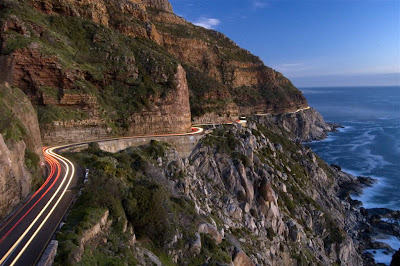
Just two narrow lanes carved into the side of an impending cliff-face that extends 600 meters over your head and falls nearly as far into the crashing Atlantic below, it offers the kind of driving that inspires the dreams of motoring enthusiasts and colours the knuckles of their not-so-adventurous companions gleaming white. If you can pry you eyes away from the road you’ll be lavished with 180-degree panoramic views over the blue Atlantic, across the white sands of Noordhoek’s 8-kilometer long beach, until the last few rocky outcrops of the peninsula curve just out of sight.

The roads 114 twists and turns eventually deliver you to Noordhoek where you’re greeted by Cape Point Vineyards, home to some of South Africa’s most highly acclaimed wines, including Sauvignon Blancs that make regular appearances in the 5-star John Platter SA Wine Guide rankings and which have easily broken through the 90-point benchmark set by Wine Spectator for “outstanding wines of superior character and style”. Not widely available, these wines are a true reflection of the local terroir and the perfect welcome in a glass.

Next stop, go for a meander in the Village – the tourism office is located here along with a collection of shops and restaurants, not least of which is the humbly-named Food Barn. The chef, Franck Dangereux, spent his early years training in 3-Michelin starred restaurants in France before eventually joining the team at Constantia Uitsig’s La Colombe, where his influence helped make it one of the world’s top 50 restaurants. Now he’s realising his dream of running his own restaurant and spending more time with his young family. You can choose to dine in or shop the deli for a bounty of culinary delights – locally sourced artisanal cheese, olives and spreads, even quiches and to-die-for gourmet sandwiches. Did I mention the on-site bakery? Only those of merciless willpower can withstand the temptations of the multitude of fresh cakes, pastries and bread that seem to stand in formation like a small army intent on liberating your waistline.

Once you’ve made your contribution towards the ‘Battle of the Bulge,’ make your way towards the Common where you can spread out your treasures for a casual picnic, wander along the babbling stream where hundreds of Arum lilies bloom in springtime, or get to know the equine beauties resting in the adjacent paddocks. No ordinary creatures, these gentle beasts with their soft, chestnut eyes and curious nature are mostly investments of the purebred kind. If you fancy a sunset ride along the beach, never fear – the folks at Sleepy Hollow Horse Riding just down the lane will completely kit you out with riding gear, a safety lesson and a trusty (if semi-retired) steed.

Following the road towards the beach, you’ll come across the Red Herring – a local institution that hosts formal wine and food pairing evenings next to a roaring fire. Upstairs you’ll also find Skebanga’s, a casual pub famous for its range of pizzas, rooftop terrace and local flair. Live music is also a regular feature.

Just across the road you’ll find the turnoff to Monkey Valley – a collection of timber chalets nestling in the embrace of the Milkwood forest. My favourite is along a private pathway towards the beach, complete with a wraparound terrace and a millionaire’s view – 180-degrees of undeveloped bush, a seasonal lagoon (and occasional home to migrating pink flamingos), and unspoilt beach – all wrapped up in the sounds of the sea. Sitting on your terrace, the sun starts to set. The horses and their riders appear as if on cue, making their daily formations across the sand. It’s Golden Hour now – the dunes are rich in colour from green to dark brown and billowy yellow. A little later the sounds of frogs present themselves, punctuating the silence of nature.

If you’re lucky, the rare Leopard Toad might make a quick appearance while fireflies dance on the horizon, as if to add their glow the sky now radiating hues of yellow, orange, pink and purple. One by one, thousands of twinkling lights join in the chorus, illuminating the sky as it gradually grows darker – not dazzling city lights this time – but stars.

THE DETAILS

Where to Eat:

  • The Food Barn: Restaurant (reservations a must) and Deli; www.thefoodbarn.co.za
  • The Red Herring (formal) or Skebanga’s Sunset Bar (local is lekker): www.theredherring.co.za

Where to Stay:

  • Monkey Valley: Live like a millionaire, if only for one night in these private, self-catering chalets; Restaurant on on-site; www.monkeyvalleyresort.com

What to Do:

  • Cape Point Vineyards: Wine Tasting options priced at R10, R30 or R50; Mon-Fri 09h00-17h00, Sat 10h001700 and Sun 10h00-16h00; www.noordhoekvineyards.co.za
  • Shopping at the Village
  • Picnic in the Common
  • Beach Walk
  • Sleepy Hollow Horse Riding: 2-hour beach trail from R400 per person; www.sleepyhollowhorseriding.co.za

Sunday, March 13, 2011

Scenic Drives of South Africa

Few things in life bring to mind such idyllic thoughts of freedom than the road trip – of driving through wide open spaces, the wind in your hair and the thought that you can go just about anywhere. Most visitors to South Africa have heard of the Garden Route, but with its stunning natural landscape, impressive rock formations and deep gorges, South Africa has even more to offer. Try one of these rides on for size and you’re guaranteed a view you’ll remember for a lifetime:

Camp’s Bay to Chapman’s Peak, Cape Town

Begin your journey just 5-min from the City Bowl. The well-maintained road descends into the arms of famed Camp’s Bay, framed on your left by the Twelve-Apostles, part of the Table Mountain range, and on your right by the sea. The road hugs the mountains and meanders south through Hout Bay, culminating along Chapman’s Peak Drive where dramatic rust-coloured cliff-faces extend above before succumbing to the crashing sea below.

Sani Pass, Drakensberg

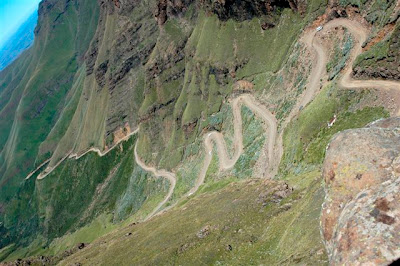
This drive is not for the faint-hearted, the novice driver, nor the average rental car. The landscape is stark, the road is unpaved and potholed, and don’t even think about the state of the guardrail (there isn’t one). One treacherous hairpin curve after another, this adventure road climbs up into the clouds until you reach the mountain kingdom of Lesotho where you’ll want to calm your nerves with a drink at the highest pub in Africa.

Swartberg Pass, Klein Karoo

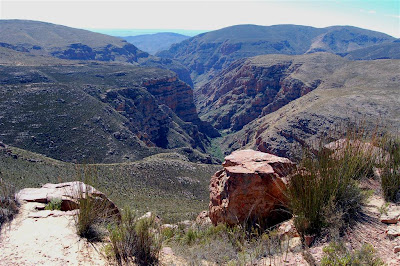
Between Oudsthoorn's Cango Caves and Prince Albert, this unpaved road tip-toes along the mountain’s edge offering sweeping views of the shrubby Karoo-landscape far below, a gentle welcome before it takes you on a journey of secrets, bobbing and weaving its way through canyon rockwalls as old as fossils, giant proteas that flower pink and yellow in season, and endless varieties of the fynbos so unique to South Africa.

Route 62, Western Cape

Rolling vineyards, tidy farmhouses and quaint country villages give way to the dry openness of the Karoo between Ashton and Oudsthoorn on this scenic alternative to the N2, dubbed the longest wine route in the world. On a summer’s day the heat along this route rises in shimmering waves – if it’s too much, take one of the many roads heading south towards the sea where you might be lucky enough to find a cooling waterfall bursting from the craggy mountain face.

Seweweekspoort, Klein Karoo

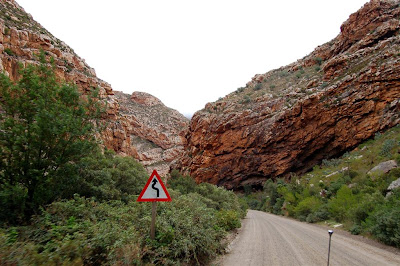
The lines in the jagged rock walls that line either side of this narrow road reveal the crushing tectonic power that formed them – vertical lines slope to horizontal and back again. Hues of red, orange and yellow blanket the space. In the quiet of centuries, one can’t help but think back to the days of pioneers, when this keyhole through the seeming impenetrable mountains provided a merciful escape from the hardships of the interior.

Monday, March 7, 2011

Humble and Historic – Tulbagh Awaits

Tulbagh. It’s a place that’s just out of reach but one that seems to keep its hold on you long after you’ve left. Beyond the grasp of tourism, one and a half hours from Cape Town, it’s an historic haven off the beaten wine lands tracks in Stellenbosch and Franschhoek. A rare treasure, its honest authenticity has survived its modern day need to play on the world stage as a premiere wine making region.

Church Street is perhaps the most famous example of Tulbagh’s past – building after building it is a national monument of Cape Dutch architecture, painstakingly restored after a devastating earthquake destroyed the original structures back in the 1940’s. Perhaps it was only a latent aftershock from the “big one” that must have formed Tulbagh into such a dramatic valley so many millennia ago.

No longer private homes, these days the national monuments of Church Street have mostly been converted into an array of B&B’s, curios and cafés. With all the modern excitement it’s difficult to imagine the truth of the past, when Tulbagh’s first citizens bustled along this lane conducting the business of the day. But for the observative, a raw reminder of Tulbagh’s founding souls can be found at the Church itself, just at the edge of town. Walk through the gates and the respect of generations will envelop you as your eyes settle on one ancient tombstone after another. The names, the dates – the only thing these souls have left on God’s earth – now crumbling into the distance, about to join the bones of their patrons in surrender to the elements. Nothing lasts forever – and to me it feels like an honour to hold testament, if only for a moment.

Just a few minutes out of town, the road meanders into the countryside past picturesque wine estates. Drostdy-Hof Manor stands watch like old faithful, flanked by others who hold the valley’s humility steadfast whilst making an impression on the palettes of unsuspecting wine lovers everywhere: the fourth-generation Twee Jonge Gezellen Estate “The House of Krone”, Saronsberg Cellar, and the historic Oude Compagnies Post. It’s easy to get swept up in the romance of the place – and the chapel at Montpellier stands like a beacon to such notions, its small stature belying its position amongst the vines on a hillside of monumental beauty.

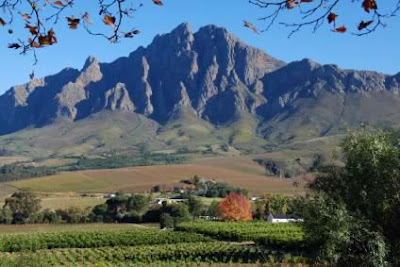
It seems to me that the people who visit Tulbagh have something in common with the people that live there – maybe we’re drawn by the call of the mountain range, the quiet that moves on the breeze, or even the past that seems to whisper from every rock, nook and cranny. Something draws us all there – something that makes the jagged mountain peaks that curve overhead in the shape of a horseshoe landscape feel like home’s embrace.

Saturday, February 26, 2011

Lucky Charms & Sensational Bites: Port Elizabeth’s Narai Siam Thai Kitchen

Located in an unassuming converted house on a quiet, out of the way street in Newton Park, Narai Siam Thai Kitchen’s exterior seems ho-hum, a striking contrast to the inside, which makes you feel like you’ve been carried away by a crowd of Thai nationals in an Asian version of Carnival. Every table, wall and even the ceiling is adorned with authentic Thai tapestries in hot pink, yellow, green and blue. Shimmering mirrors reflect light like little disco balls, making the space feel larger than life. The feeling is festive, casual, and definitely fun – perfect for groups in a celebratory mood.


This is the vision of Colin Beelders and his partner, a Thai national. Over the years they have painstakingly sourced each element of the décor in Thailand and travelled with them back to South Africa. Apparently the décor does much to inspire the guests and some, the owners say, are simply overwhelmed by the temptation to tinker with the glittering ornaments, even slipping them into their handbags alongside extra dinner mints. Colin explains, “Unfortunately things are sometimes stolen or broken,” he shrugs, “sometimes we get them back.”


Colin continues, “The restaurant’s name is inspired by a Thai king whose temple in Lopburi is most famous for its annual Festival of Monkeys.” The temple has become a tourist attraction since 2,000 monkeys decided to take up residence. These crafty monkeys have a habit of sneaking up on unsuspecting tourists and pick-pocketing small items like car keys or snacks before scampering off. I can’t help but make the correlation between the monkey-thieves at the temple in Thailand and patrons in Port Elizabeth who would pause between bites to strip the walls of their ornaments.


Determined to leave things in their place, my friend and I are looking forward to our lunch out on an otherwise average day. We make small talk with our host who brings us order-by-number menus. There is something to be said for these – somehow I always fool myself into believing I don’t need the extra help but invariably realize after several mangled attempts at Thai that ordering by number isn’t so bad after all.


We start with easy-to-pronounce Tom Yum Soup, a house specialty, and order a bottle of Noble Hill Sauvignon Blanc – a perfect companion to Thai food because of its lemony, crisp finish. The soup is warming and has just enough spice to balance the sweetness. For the entrée we decide to share two of the restaurant’s signature dishes, my favourite, #13 (that’s Kang Keow Wan Gai – sweet green curry)with chicken, and #42 (Pad Nam Phrik Phao – stir fried and roasted chilli paste) with beef. In both dishes, the vegetables are perfectly cooked – seared but still crisp fresh. The rich coconut of the green curry is complemented by mild spice and lifted by the zing of lemongrass – the combination is a gentle dance in my mouth. The chili dish by contrast is feisty and full of kick, richness and depth of flavour. As the restaurant starts to fill with aromas from the kitchen and the energy of other patrons the space is transformed into a mid-day’s party. Just a few bites in and we are loving the food and the vibe.


When the coast is clear we sneak away to have a peek at the infamous men’s loo – where the interior is guaranteed to bring a laugh, if not a blush as red as sweet chili sauce due to the many phallic statues adorning the space. Obscene and hilarious to us westerners, it turns out we are missing the point entirely. These figures are lucky charms, known as Palad Khik, and have been highly regarded in Thai society since the 8th century AD for their powers to bring good luck, prosperity, protection against evil forces and last but not least – to increase one’s sex appeal. Quite the norm in Thailand, they are even worn as necklaces.


I don’t know about you, but I somehow doubt I could ever fall head over heels for a man wearing a giant phallic charm around his neck, but I suppose one never really knows until one is faced with the situation.


We return to the table giggling. We catch our breath and turn to high-five the table of ladies next to us – their turn is up. Still feeling flushed, we decide to cool down over Thai iced teas – brewed to perfection, they are sweet, authentically Thai and beautiful to look at – just like the restaurant, which seems to have made it to the end of lunch largely intact. Although I haven’t seen anyone slipping trinkets into their takeaway boxes it still feels like we’ve got up to a bit of mischief – sort of like those monkeys living in the famous temple in Lopburi. Something tells me King Narai would be proud.

  • HOURS: OPEN FOR LUNCH & DINNER, MON – SAT, 12H00 ‘TIL 23H00
  • LICENSED: YES; R35 CORKAGE FEE
  • AMBIANCE: CASUAL & FUN, LIKE THE FESTIVAL OF MONKEYS
  • AVERAGE MAIN COURSE: R55
  • ADDRESS: 20 WORRAKER STREET (BETWEEN 2ND & 3RD AVENUES), NEWTON PARK, PORT ELIZABETH
  • TEL: 041 363 8126

Saturday, February 19, 2011

Global Gourmet: The Restaurant at Clos Malverne

A flair for contemporary classics and complex flavour combinations are just two of Nadia Louw Smith’s culinary talents, as Theresa Lozier discovered when she chatted to Clos Malverne’s executive chef over a sophisticated seasonal lunch.

Childhood memories – we all have them. Those moments that stay with us our whole lives, taking us back to the way we felt, to the sights, sounds, and smells that we had for that fraction of time. For some of us, like Nadia Louw Smith, a childhood experience can have the power to influence the course of our lives.

“I remember my family going to my grandmother’s home for Sunday lunch,” she explains. “The house was always filled with the smells of her freshly baked bread and traditional roast. Those were very happy times.” She continues, “My grandmother was my biggest influence and inspired me to follow my interest in food. Being in the kitchen never felt like work to me – it was always fun, creative – and I often helped my mother in the kitchen in the evenings. After a while, my dad used to tease her that my food was better!” She laughs gently, and the twinkle in her eye belies her humble demeanor.

Her father was right to take note of her early talent. Nadia’s career has spanned South Africa’s culinary landscape – from five-star luxury at Cape Town’s Mandela Rhodes Place Hotel & Spa, to the Cederberg’s world-renowned Bushmanskloof Wilderness Resort (hailed as the “Best Hotel for Food” by Condé Nast Traveler magazine), and the cosmopolitan flair of the Cinnamon Boutique Restaurant in Wilderness. In 2009 she traded the shores of the Garden Route for the rolling hills of the Devon Valley outside Stellenbosch, becoming the driving force behind the launch of The Restaurant @ Clos Malverne.

Nadia relfects, “I’ve been here since the beginning – since the launch of the restaurant. I wouldn’t have it any other way. I get to set the standards, train the staff and the menu is me – it’s my food. I love combining flavours and, since the wine adds such an important dimension to the dining experience, I really enjoy the added complexity.”

Located 40-min from Cape Town, Clos Malverne is an idyllic country getaway set among the vines. Its gorgeous spa is a highlight for those looking for some daytime pampering - combined with lunch, visitors can really get away from it all. Other drawcards include award-winning wine, a sophisticated yet approachable setting, the wraparound balcony with a view of the vines and unpretentious, global cuisine.

As executive chef, Nadia ensures the menu takes its cue from nature – most of the fresh greens come from the wine estate’s own organic vegetable and herb garden – and offerings change every few months to make the most of the seasons. As much as possible, ingredients are sourced locally and handcrafted onsite – like the Franschhoek salmon trout that Nadia cures herself. A cosmopolitan influence of flavours is evident on the menu but the common denominator is a feeling of down-to-earth accessibility. Nadia says, “There are so many cultures to be inspired by – even here in South Africa, our food reflects our diverse roots – we have Dutch, Afrikaans, English, Malaysian, Indonesian, and Indian influences – and it’s wonderful to enjoy these flavours as contemporary classics. Soon we’ll even be launching a series of five-course gourmet evenings where we’ll have a bit of fun celebrating these flavours with all the style of fine dining.”

The lunch menu is made up of three indulgent courses, incorporating complex flavours like dill, thyme, citrus, and star-aniseed. For starters, Nadia recommends the tempura prawns served with a homemade chili sauce – the crispy batter, sweet meat and hot spice are complemented by a cool mango salad and paired with the estate’s crisp Sauvignon Blanc. For mains we try Nadia’s personal favourite, the orange and star-aniseed marinated duck breast, served with roast vegetables and a sweet potato cake that is coated in bread crumbs and fried until crisp on the outside. The combination of textures and rich, deep flavours pair well with the estate’s slightly fruity shiraz. The signature grilled beef fillet, sourced from a local farm, comes topped with your choice of sauces – but if you ask me, the creamy brandy pepper sauce is a “must-try”. Pair it with the flagship Auret, a distinctive blend of cabernet, pinotage and merlot that delivers elegant structure and just enough berry. Whatever you do, save a little space for dessert – both the vanilla pod crème brûlée and the dark chocolate fondant are to die for – the latter oozes with 80% Belgian chocolate and makes your plate an absolute mess of utter delight.

The Details:
  • The Restaurant @ Clos Malverne Wine Estate is now also open for Sunday lunch
  • A series of five-course Gourmet Evenings kick-off on Friday, 25 Feb for R295 per person
  • For more information or to reserve your table phone 021 865 2022, visit www.closmalverne.co.za or email info@closmalverne.co.za

Sunday, February 6, 2011

Revel in Romance & Rosé this Valentine’s at Simonsig’s Cuvée Restaurant


It’s February in the Cape – summer’s happiest month – and Valentine’s Day is just around the corner. You know the one – that day that’s steeped in nostalgia and fairy tales, rooted in loving proclamations, reckless abandon, confessions and promises, filled to the brim with sweet nothings and everything else in between. It’s a day of passion – passionate love for some and fear and loathing for others. Will you have an unforgettable one? Will you find that someone in time? Or do you think it’s just a lot of hoo-haw invented by the likes of Hallmark? No matter which side of the emotional fence you’re sitting on we can’t seem to get past this day without feeling something and to be honest, so far I’ve been feeling like a bit of a skeptic.

After all, Valentine’s falls on a Monday this year – the most mundane of all days in the week – and with a job full of travel and tired evenings it seems like a lot of effort just to say “I love you” to someone I see every day. So when my special someone suggested we make it our own day and celebrate a little early, I was surprised to hear myself instantly agree, taken over by the whims of my secret romantic side or perhaps shot through the heart by Cupid’s golden arrow.

And so it was that we found ourselves at Simonsig’s signature restaurant, Cuvée, for an afternoon of carefree conversation, fine dining, premium wine and celebration. Upon arrival we were treated to a tasting of the Méthod Cap Classique range – lifting our spirits like the bubbles in our glasses. I must have forgotten my inner skeptic back in the car since I forgot all about my initial reservations while wandering under the oaks in the garden.

Set under a vine-covered trellis, the Cape Dutch building created a romantic setting and the nearby fountain trickled a slow melody in the heat of summer’s embrace. It was a cool relief to come indoors and sit like VIP’s, enjoying the view of the mountains framed by floor-to-ceiling drapes in soft hues of beige, cream and sultry grey. The darkness of the wood floors and tables created a rich feeling and the sound of jazz vocals moved softly through the air, a faraway voice of crystallized emotion. A modern mix of kitsch and style, the décor included chandeliers formed by a medley of glassware and china, suspended from the rafters in the double volume space above us, and silver light fixtures gleaming from their view of a century’s old wine press.

In the spirit of the occasion we chose the Rosé-inspired menu, only available until the end of April, which celebrates the earthy, berry flavours of the Simonsig Kaapse Vonkel Brut Rosé. Our waitress, Wilma, treated us to a graceful balance of attention and privacy between courses. We started with a taste of tender-crumbed bread, bursting with sundried tomato, offset by butter cream. Next we indulged in ostrich carpaccio, presented with cherry compote, earthy green sprouts and tangy goat’s cheese, drizzled with a red wine glaze. The combination of sweet and sour, creamy and sharp danced together in our mouths. Our entrée was an experience in each bite – seared tuna, perfectly pink in the centre – sealed in a jacket of coarse pepper, complemented by star-aniseed roasted plums, anointed with a creamy lemon butter sauce and punctuated by bits of walnut that melted in happy glory. Dining on this food made us feel like royalty but we weren’t finished yet – our final en core was a palette-cleansing dessert of icy orange marmalade and macerated berries that left us feeling refreshed, light and completely spoilt.

After this experience my inner skeptic seems to have vanished without a trace, and with a few weeks left before the “official” Valentine’s Day I’m starting to rethink my feelings on the matter. Why not celebrate with your best friend on that one day of the year? Does it really matter how the tradition began so long as you believe it? And if there’s any way to take the ‘mundane’ out of Monday, a brush with Cupid and time at Cuvée certainly can. Looks like I’ve been shot through the heart after all.

It’s not too late - reserve your Valentine’s Evening at Simonsig’s signature restaurant, Cuvée – perfect for pampering or even a proposal under the stars. The 3-course dinner includes live jazz by The Limehouse Trio, a bottle of Simonsig Kaapse Vonkel Brut Rosé and a box of handmade chocolates. 19h00 on Monday, 14 February for R350 per person. Vegetarian options are available upon request. Choose between:

· Starter: Roasted Duck, Beetroot and Pomegranate Salad OR Venison Carpaccio served with Crisp Apple, Gooseberries and Mustard-Dill Sauce

· Entrée: Beef Fillet Medallions enriched with Roquefort Cheese, Walnuts and Wild Mushrooms OR Sesame-crusted Norwegian Salmon with Wilted Greens

· Dessert: Dark Chocolate Fondant with Cherry and Marzipan Marbled Ice-cream, and Cointreau-infused, Macerated Watermelon with Orange Zest and Watermelon Sorbet

THE DETAILS:

· AMBIANCE: Romantic luxury – it’s Valentine’s all year long

· LOCATION: Outside Stellenbosch, on the Kromme Rhee Road between the R44 & R304

· HOURS: Lunch Mon-Sun 11H00-15H00; Dinner Wed, Fri, Sat: 19H00-22H00

· EXTRA SPECIAL: Book a private occasion in the luxurious Van Niekerk Room

· RESERVATIONS: Phone 021 888 4932 or email cuvee@simonsig.co.za

Note: The Rosé-inspired menu is available for a limited time until the end of April. Available as a set two- or three –course menu for lunch or dinner, it includes a flute of Simonsig Kaapse Vonkel Brut Rosé. R160-R190 per person